NZ Rural Contractors Push for Urgent VDAM Rule Reform
While the Government has moved quickly to make commercial hauliers' lot easier during the current fuel crisis, they appear to be stuck in the creep box when it comes to the agricultural industry.
 increase font size
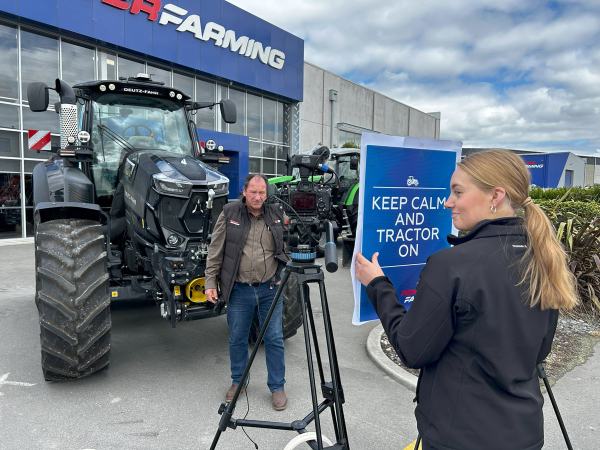 RCNZ's Steve Murray with Power Farming Canterbury's Sophia Dean.
Rural Contractors NZ have launched a campaign today against the risks of fatigue in their industry.
RCNZ chief executive Andrew Olsen says because they work seasonally, drive big machines and face weather and crop timing challenges, rural contractors need to manage fatigue risks.
“We are saying there are risks for everyone if you push yourself or others too hard.”
Steve Murray, a second-generation Canterbury rural contractor and former RCNZ president has fronted three short videos. These have been professionally produced by farm machinery supplier Power Farming which has previously worked with Steve and is right behind the campaign. These include one video aimed at employers.
“Rural contractors take their health & safety responsibilities seriously, but the video says they need to talk about the F word – fatigue,” says Andrew Olsen.
“Our members are up against it with the weather, crop deadlines and client expectations but they can put themselves and their staff under too much pressure. They need to build in breaks and pace things so no one gets fatigued which can cause stress and much worse.”
A second video is aimed at employees. “They’ve also got to do their bit to avoid fatigue. That includes not arriving at work really tired or stressed or hungover or unwell; if they are, or see others with such effects, they’ve got to sing out to avoid people are being put at risk.”
The third video gives tips on avoiding fatigue including eating good food, drinking lots of fluids and taking breaks. The videos are supported by more detailed material on the RCNZ website.
Olsen asks all stakeholders to view and share the campaign’s details including farmers and other landowners.
“We all have a role to play. Rural contractors can sometimes be put under too much pressure to meet impossible deadlines especially when the weather plays up and crops need harvesting.
“Big machines may be able to operate 24 hours a day but those behind the wheel need their sleep and breaks to be able to do the job safely.
“The last thing anyone wants is for a fatigued driver to do harm to themselves or someone else. We are saying let’s all work for a safe season by avoiding fatigue.”
While the Government has moved quickly to make commercial hauliers' lot easier during the current fuel crisis, they appear to be stuck in the creep box when it comes to the agricultural industry.
Ensure your insurance is fully comprehensive and up to date because as a rural contractor you don’t know what’s around the corner.
Rural contractors are getting guidance on how to deal with recent rising fuel prices.
Rural contractors want the Government to include a national standard for air plans as part of its Resource Management Act reforms.
Concern about fatigue impacts during a busy season prompted Rural Contractors New Zealand to launch a campaign about the risks. Chief executive Andrew Olsen explains.


Synlait has swung to second-half profit as operations stabilise, but the dairy processor still posted a $75.4m annual loss.

LIC shareholders have elected a new North Island representative to the co-operative's Board, along with five representatives to its Shareholder Reference Group (SRG), following the company's Annual Meeting held in Invercargill.
Farmers across parts of Southland and South Otago are continuing to deal with difficult conditions after a prolonged run of wet weather, with pressure building around feed supply, stock management, pasture damage, farm infrastructure and everyday workloads.
Federated Farmers says it welcomes Labour's commitment to reviewing the Sharemilking Agreements Act, calling on other major parties to do the same.
For Canterbury dairy farmers Sian Meijer and Rick Wobben, wearable technology has become one of their most valuable on-farm tools - helping manage 1850 cows across an expansive, high-performing dairy operation while improving efficiency, mating outcomes and day-to-day decision making.
Fonterra has unveiled its annual results for the 2026 financial year, posting $27 billion in revenue and close to $20 billion returned to New Zealand farmer owners and unit holders.