Fall Armyworm in NZ Maize: Four Years of Research
Four years since it was first detected in New Zealand, researchers and growers now know much more about management of maize pest fall armyworm (FAW).
 increase font size
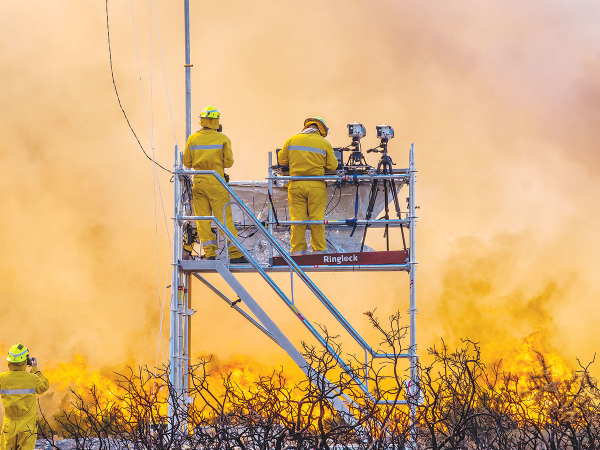 Experimental research burns near Christchurch will test new theories on how wildfires spread under various conditions.
Scion is running experimental research burns near Christchurch from March 3-14, to test new theories on how wildfires spread under various conditions.
It is thought this will help improve operational and community readiness for and response to future events - and enhance firefighter and public safety.
The research will involve a series of stubble fires (harvested agricultural paddocks that still have standing dry barley and wheat crop stalks). Scientific instruments will be used to collect data on fuels, weather and fire behaviour. It is a collaboration between Scion's wildfire researchers, Fire and Emergency New Zealand, the University of Canterbury, the United States Forest Service and San Jose State University.
Understanding how fire behaves helps improve the models we use for predicting future wildfires in the NZ landscape and internationally. Better prediction means we can more effectively plan and prepare for future fires and more safely respond to existing ones - to help keep people, property, animals, and the environment safe in the event of a wildfire.
Scion fire ecologist Shana Gross says this is important as, globally, wildfires are becoming more frequent and severe, with fire behaviour in real-world conditions often defying existing models.
The burn window is based on paddock harvest dates and the weather. A burn plan has been completed and a permit will be obtained prior to the burns in accordance with the current fire season status and requirements.
"Scion will implement rigorous safety measures for each experimental burn regardless of fire season status, in collaboration with Fire and Emergency," Gross says.
Canterbury is currently in a restricted fire season. Safety measures for this research include having meteorologists and fire specialists on hand to assess weather conditions, having firefighters and equipment on site to suppress fire and creating fire breaks necessary for the conditions during the burns. Standard practice for stubble burns is 6m of fire break on all sides of the fire. Additionally, many of the New Zealand and international researchers involved are trained wildlife personnel. People are also asked to keep their distance from the fires.
The burn window gives researchers flexibility to burn within suitable weather conditions. "We review weather constantly in the lead-up to this window," Gross says.
"We will make a call about the first burn day 2-3 days before the window, confirm it the night prior, and make a final decision right before ignition. We will burn when weather conditions align and instrumentation has been set up."
Scion aims to burn on 5-6 days during the 12-day window.
Stubble fires provide an opportunity to create continuous burns/flame fronts to allow researchers to analyse flame structure and fire behaviour.
"The learnings and improved models and predictions gained from experimental research burns aim to enhance NZ's resilience to wildfires, improve safety, enhance response strategies and tactics and reduce the impact and frequency of wildfires," Gross says.
This research is funded by the Ministry for Business, Innovation and Employment and supported by the Rural Fire Research Advisory Committee.
Four years since it was first detected in New Zealand, researchers and growers now know much more about management of maize pest fall armyworm (FAW).
Generative AI in the workplace, trials in the field, and industry-relevant research took centre stage at this year’s Grape Days events in Central Otago, Hawke’s Bay and Marlborough.
OPINION: The Government's announcement that it will create a new advanced technology public research organisation (PRO) is sparking conversations about what advanced technology means for New Zealand, and for the research and innovation needed to grow our economy.
Scientists from the Ministry for Primary Industries (MPI) are part of an international team working to develop a low-cost diagnostic tool that could significantly improve food crop production in developing countries.
The government has announced a major restructuring of the country's seven crown research institutes (CRIs), which will see them merged into three public research organisations (PROs).



Waikato milk processor Tatua has again declared a record milk payout to farmer shareholders, leaving other processors in the dust.

A Labour-led Government won’t be bringing back the controversial freshwater rules of 2020.
National’s much-touted free trade deal with India featured in the Rural Issues Debate at Mystery Creek, Hamilton on Wednesday night.
New Zealand's 2026-27 freshwater fishing season has opened, with anglers encouraged to head to rivers and lakes over the coming days as conditions look favourable across much of the country.
Central Otago District Council (CODC) has voted against a plan to spread treated sewage sludge from Cromwell and Alexandra on farmland near Lauder, a decision Federated Farmers says reflects strong opposition from rural residents.
Pāmu has released its FY26 Integrated Annual Report, reporting a Net Operating Profit of $113 million, more than double the $49 million recorded in FY25.