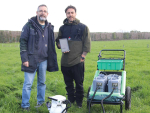
Massey Uses Portable Analyser to Measure Pasture Soil GHGs
Researchers at Massey University are using a special piece of scientific equipment to improve the measurement of greenhouse gas emissions from pasture soils.
 increase font size
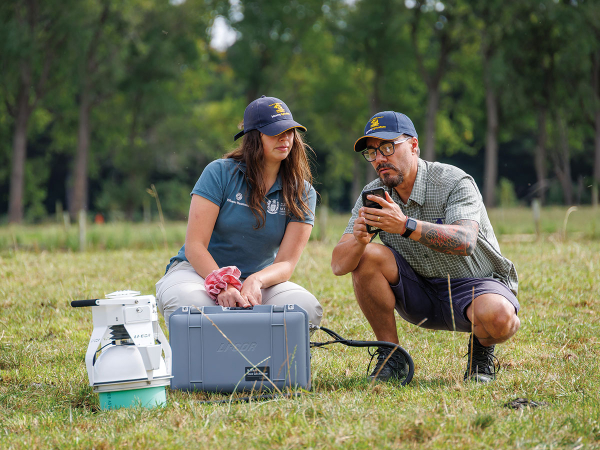 Senior Technical Officer Eduardo Sandoval demonstrating LI-COR readings.
Massey University says its stand at the Fieldays will showcase regenerative science and “circular bioeconomy innovation supporting more sustainable and resilient farming systems”.
The Massey stand (site PE51) and at the Ministry for Primary Industries (MPI) Science for Farmers site will allow visitors to explore how science innovation is shaping the future of the food and fibre sector in Aotearoa New Zealand.
With a focus on sustainable systems, Massey is highlighting the vital role invertebrates play in improving soil health, managing organic waste and supporting resilient farming systems.
Around 30% of food is lost or wasted across the agrifood chain, from farms and orchards to supermarkets and homes, representing a significant untapped resource.
Massey researchers are exploring how this waste can be repurposed using an unexpected ally – Black Soldier Fly larvae.
Associate Professor in Ecology and Zoology Dr Maria Minor specialises in the ecology of soil invertebrates.
She says circular approaches treat waste as a resource, using processes like composting and bio-conversion to reduce landfill pressure and close nutrient loops.
“They’re capable of consuming up to twice their body weight daily. In roughly 15 days, they can convert organic waste into, on average, two to three kilograms of nutrient-rich frass (fertiliser) for every one kilogram of larvae, while reducing waste volume by up to 80 per cent. They are one of very few animals able to convert organic waste into usable protein,” Dr Minor explains.
Visitors to the stand can see the larvae, provided by the Bioeconomy Science Institute, breaking down compostable food scraps in real time and demonstrating how these natural recyclers convert waste into valuable nutrients.
Massey researchers will also be demonstrating cutting-edge greenhouse gas monitoring technology at Fieldays.
Following the recent acquisition of portable trace gas analysers, the team will showcase the LI-7820, which enables real-time measurement of nitrous oxide emissions from land.
Senior technical officer Eduardo Sandoval and his team will provide live demonstrations showing how the technology captures rapid changes in emissions across different paddock types, times of day and seasons.
These insights help researchers understand how various crops and farming practices influence emissions, supporting the development of more effective mitigation strategies.
Sandoval says the technology is particularly valuable given our country’s unique soil types, management and farming systems.
“Building a deeper understanding of our own environment is essential to ensuring future farming practices and mitigation approaches are well-informed and genuinely suited to New Zealand conditions.”
The LI-COR technology plays a key role in the Whenua Haumanu programme, New Zealand’s most comprehensive regenerative and pastoral agriculture research partnership.
The seven-year programme, in partnership with MPI, focuses on understanding how farming practices impact the environment, with research spanning soil health, biodiversity and wider ecosystem outcomes, while maintaining productive and resilient farms.
Now halfway through the programme, the Whenua Haumanu team will be at the MPI Science for Farmers site, sharing research progress and connecting with farmers, communities and industry.
Visitors can also hear Massey researchers and staff sharing their expertise during several MPI Science for Farmers panels.
Professor Danny Donaghy will speak on resilient pastures and climate modelling for the future at 12pm on Friday 12 June, while Professor Lucy Burkitt will present on freshwater and catchment solutions at 1pm the same day.
Nutrition lab manager Kelly Coxhead will speak on the Wāhine toa o te Whenua panel on Thursday 11 June at 1pm, where she will join other emerging female leaders to share insights into their experiences and the diverse career opportunities within the food and fibre sector.
Massey’s Nutrition Lab provides accredited testing and consultancy for food, pet food and agricultural products, supporting clients worldwide with services including food safety, labelling, product formulation and shelf life.
Massey University is also highlighting innovation in sustainable materials through Te Aho Tapu Hou, a NZ-first project transforming harakeke (flax) muka fibre into high-value textiles.
By combining traditional Māori knowledge with modern fibre science, the project is developing new processes to produce industrial yarn, unlocking opportunities for sustainable, Māori-led enterprise while supporting environmental restoration.
Visitors can see this innovation brought to life through woven textiles on display at Massey’s stand, showcasing the beauty and versatility of this natural fibre and the connection between art, culture and sustainability.
The project was made possible thanks to partners Muka Textile Ltd, Bioeconomy Science Institute Maiangi Taiao, Te Whānau Harakeke, and funder Ministry for Business, Innovation and Employment: Vision Mātauranga Capability Fund.
Academic and Future Student Advisors will be available throughout Fieldays to discuss study options, career pathways and student life at Massey.
With more than 150 qualifications on offer, our advisors can set you on the right course for success.
Visitors can also try ‘edible worms’ – chocolate-flavoured, worm-shaped puff crisps made at Massey’s FoodPilot, enter to win prizes by scanning their Fieldays Smart Band, and keep an eye out for everyone’s favourite mascot Fergus, popping by throughout the event.
Researchers at Massey University are using a special piece of scientific equipment to improve the measurement of greenhouse gas emissions from pasture soils.

Interest in agritech and production animal systems has prompted Massey University's School of Agriculture and the Environment to new majors to its popular animal science degree.
The industry is crying out for graduates with agricultural related degrees.
A four year trial has reaffirmed that mixing plantain into dairy pastures can help reduce nitrogen losses to freshwater while maintaining milk production and profitability, say researchers.
Special courses for secondary school teachers to help excite kids about agriculture and horticulture are now being run at Massey University.


South of the central Hawke’s Bay town of Waipukurau is Taniwha Station – a highly successful 550ha bull beef farming operation.
Beef + Lamb NZ funded research has shown that some simple changes to pasture management could help farmers make better use of rainfall and build resilience before dry conditions hit.
OPINION: There could hardly be a more appropriate theme for a conference than the one chosen by the red meat sector - Navigating Volatility.
When Northland leather worker Vernon Suckling started making horse saddles 50 years ago, quad bikes and side-by-side vehicles were unheard of.
Alliance Group has confirmed that eligible farmer-shareholders who supply and continue to back the business will receive up to $20 million later this year, following the strategic investment partnership with Dawn Meats.
With a general election under five weeks away, Rural News is asking major political parties about their policies and positions on key issues facing the primary sector. We will run their responses to each question over the next four weeks. The ACT Party and the Greens didn't respond in time.