It's The Margins That Matter
OPINION: It appears to be difficult for people who haven’t tried to run a business to understand the difference between assets and cash.
 increase font size
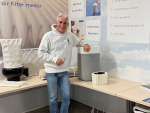
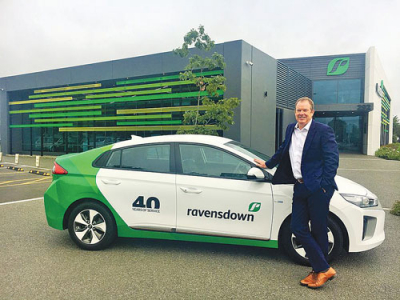 Ravensdown chief executive Greg Campbell outside the company’s new office.
Not many chief executives would happily advocate for sales of their products to go down, but Greg Campbell, head of the fertiliser co-op Ravensdown, wants just that.
“It’s very unusual for a chief executive to say that, but my passion would be for us to use less nitrogen, phosphorous and sulphur while maintaining or improving our productivity,” Campbell told Rural News.
“The challenge is to how to use less [of these] in our eco system and maintain or enhance productivity -- making sure that as a country we protect our real brand.
“I see us very much fitting in that game; not many chief executives are happy to see their top line reduce because if [that happens] the cost to our customers and shareholders goes down -- they are not using much of our products.”
Campbell points out that Ravensdown, started 40 years by a group of South Island farmers, is no longer just an importer and seller of fertiliser; its business units include animal health, agri chemicals, seeds and its star performer -- environmental consultancy.
“The really big part of our business now is our environmental consultancy; we consult and protect the social licence to operate for farmers,” says Campbell.
Ravensdown set up the environmental consultancy three years ago, responding to shareholders’ requests for help. What started with two consultants now has 17 consultants with 160 years of cumulative experience. They have undergone 2737 hours of training to increase capability and between them completed 1000 projects.
Demand is exceptionally high; the business unit is the fastest growing within Ravensdown.
Four services are offered: Overseer modeling, farm environment management plans, water quality testing and resource consent applications. Campbell says while Overseer needs “refinement”, the agri sector needs to be an output based system.
“If we become an input based system like Europe then there’s not really an opportunity for New Zealand farmers to innovate; everyone then gets put in the same box, everyone wants the same productivity outcomes.
“We know Kiwi farmers are innovative and they don’t want that.”
Campbell says the response from farmer shareholders to Ravensdown’s environmental consultancy has been fantastic. The consultants talk to regional councils on behalf of farmers and help them through regulatory challenges or consent requirements.
“Our farmers are saying to us, ‘we want your help here… collectively help us because we can’t do this individually’,” Campbell says. “Farming is now in a goldfish bowl.”
Fertiliser can been seen in two ways: if misused it can become a polluter but if used correctly with science it becomes an enabler.
“What we are really about, frankly, is our challenge as an organisation: we want to minimise the use of our products while optimising productivity; that’s our challenge.
Campbell is confident Ravensdown is leading the way in helping farmers tackle environmental issues.
“We now have the biggest environmental consultancy in agriculture in NZ; we are still recruiting and that’s our future.”
OPINION: It appears to be difficult for people who haven’t tried to run a business to understand the difference between assets and cash.
OPINION: In the 1980s, concern was expressed in West Germany about the falling birth rate. Some simple analysis was performed by Professor Helmut Sies, physician and biochemist at Dusseldorf University. His letter ‘A new parameter for sex education’ was published in Nature in 1988:
When it comes to annual rebates, it's been a long time between drinks for Ravensdown shareholders.
Ravensdown has reported a net profit before tax and rebate of $50.1 million for the year ended 31 May 2026.
Farmer owned co-operative Ravensdown has signed a two-year naming rights sponsorship of the Canterbury A&P Show.


For the first time in a quarter of a century, Federated Farmers has something positive to say about the Labour Party’s climate change policy leading into a general election.
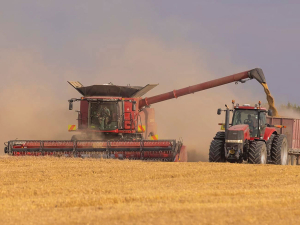
A warning for New Zealand seed and grain companies – be prepared for an exodus of farmers from the arable sector.
Now in its fourth year, the 2026 Fencing Industry Awards, formed part of the proceedings of the FCANZ Conference, held in Nelson during August.
DairyNZ deputy chair Cameron Henderson has been re-appointed unopposed for another term.
OPINION: The stats speak for themselves.
Farms across the upper North Island are trialling different pasture mixes as part of a research programme that aims to build greater resilience into farming systems.