What Would Synlait Be Worth to Fonterra or a2 Milk?
Speculation of a possible joint move by Fonterra and a2 Milk to buy Synlait raises a much bigger strategic question, says agribusiness expert Dr Nic Lees.
 increase font size
Fonterra will this month recoup $193 million from its farmers -- some of the special loans made two years ago at the depth of the dairy downturn.
The remaining $190m will be deducted from farmers’ milk cheques when the advance rate climbs above $6/kgMS, expected about August next year.
Fonterra farmers were hit by low farmgate milk prices in 2014-15 ($4.40/kgMS) and 2015-16 ($3.90/kgMS).
To ease cashflow on farms the co-op loaned $383m to 76% of its farmers; the loan was interest-free until June 1 this year and farmers have since been paying 2.4% interest. Repayments were to start only when the payout surpassed $6/kgMS.
Fonterra chairman John Wilson says the loans were “highly successful” for farmers, providing cash when they needed it.
“We did it based on our confidence in the global dairy market that once we got above $6/kgMS we would initiate the first loan repayment,” he told Rural News.
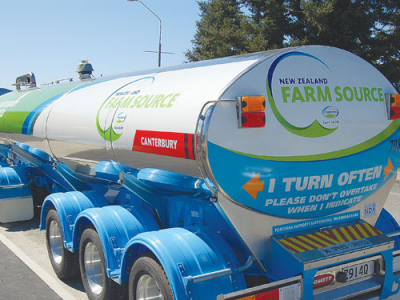
Wilson says he is also proud of the assistance the co-op’s subsidiary Farm Source provided to farmers during the downturn. “Farm Source is a lot more than what used to be called RD1. The Farm Source business has to provide a return to Fonterra while passing lower costs on to farmers.”
He says an average farmer saves 10c/kgMS by shopping exclusively at Farm Source rather than at other rural retailers.
“That’s extraordinary; if you are a young farmer up against [market] volatility that makes a huge difference.”
During the downturn, Farm Source extended interest-free and deferred-payment terms to 4000 farmers, redeeming $17.8m of reward dollars.
Fonterra last week announced a final milk payout of $6.12/kgMS for the 2016-17 season; with a dividend of 40c/share that makes a total cash payout of $6.52/kgMS.
For the year ending July 31, 2017 revenue increased 12% to $19.2 billion, and rising prices offset a 3% decline in volumes (22.9b liquid milk equivalent).
Normalised EBIT of $1.2b was down 15% as a result of reduced margins across the business, which also influenced net profit after tax – down 11% at $745m.
Wilson lauded the co-op’s ability to maintain its forecast dividend despite the milk price increasing by 57% over the year and the impact of negative returns.
At a glance
- 2016-17 total cash payout $6.52/kgMS, up 52% on last season’s farmgate milk price of $6.12/kgMS and dividend of 40c/share
- Revenue $19.2b, up 12%
- Normalised EBIT $1.155b, down 15%
- Net profit after tax $745m, down 11%
- 46c earnings per share
- Large growth in consumer and foodservice: extra 576 million liquid milk equivalent
- Advanced ingredients sales growth up 9%
- Group return on capital 11.1%.
Speculation of a possible joint move by Fonterra and a2 Milk to buy Synlait raises a much bigger strategic question, says agribusiness expert Dr Nic Lees.

In the past, much has been made of the concept of farm to fork, but an Australian expert in food science and marketing with experience in the dairy industry, Dr Angeline Achariya, says the reverse of this slogan is critical to win modern day consumers.
A four year trial has reaffirmed that mixing plantain into dairy pastures can help reduce nitrogen losses to freshwater while maintaining milk production and profitability, say researchers.
Fonterra has opened its upgraded Chengdu Application Centre, bringing New Zealand dairy expertise closer to customers in one of China's fastest-growing regions.
Tatua chair Stephen Allen says he leaves the co-op with a deep sense of gratitude for the people who have contributed to its success.


An Auckland gelato shop and an established New Zealand ice cream maker have both been named Supreme Champions at the NZ Ice Cream & Gelato Awards 2026.

As the cost-of-living crisis continues to put pressure on household grocery budgets, new figures show pork remains one of the most affordable fresh meat options for New Zealand families.
OPINION: In politics, credibility is and should be big. It must surely rank higher than charisma, which is quite trite and superficial. Yet, voters nowadays are often wooed and influenced by how someone looks or talks at a superficial level. TV plays a huge role in this.
Farmers can spend less time on paperwork, thanks to a new data sharing agreement between DairyNZ’s DairyBase and LIC’s MINDA software.
Kaikōura families affected by July's severe storm have found a practical solution to a problem that's kept some children away from regular schooling for weeks: a washed-out section of Inland Kaikōura Road, which has stopped the local school bus from running its usual route.
Rural New Zealand is welcoming the Government’s recent package of rural healthcare initiatives.