DairyNZ and Beef + Lamb New Zealand have reached an agreement on how they will split the cost of eradicating Mycoplasma bovis.
As announced in May, 68% of the costs are funded by Government and the remaining 32% is split between dairy and beef farmers.
After a challenging but constructive process between the DairyNZ and Beef + Lamb New Zealand (B+LNZ) boards, the agreement was reached on how each industry will share the cost of the Mycoplasma bovis (M. bovis) phased eradication programme.
Of the 32% of costs, the dairy sector will meet 94% of the costs of the programme, and beef 6%.
Both parties were very aware of the impact on their farmers, so sought the assistance of an independent panel to provide recommendations consistent with the principles of the Government Industry Agreement on Biosecurity Readiness and Response (GIA).
The boards of DairyNZ and B+LNZ support the panel’s view that the funding split represents a reasonable allocation for the costs of the M. bovis response, considering the relative economic size of the two sectors, the risk of infection and the potential clinical impacts weighted by the farm-gate revenue for milk and beef of M. bovis on the respective sectors.
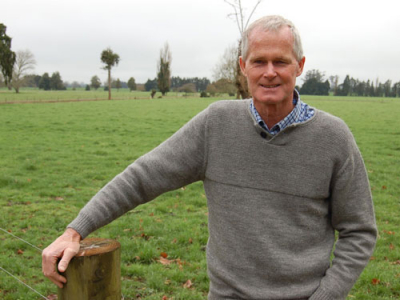
DairyNZ’s Chair Jim van der Poel says a robust process was followed and “although we are disappointed that the costs of system changes was not factored in, we also understand the difficulties of doing this, and accept the recommendations and need to move forward.
“We are very grateful for the public support and the support of the Government to assist with this eradication effort. If we hadn’t moved to eradication, the alternative – to do nothing and let this disease spread throughout our stock – would have been a serious challenge and the costs higher, estimated at $1.3 billion. This was the better outcome.
“We argued strongly that the cost split should also include the costs that would be associated with changes to farming systems in both sectors if M. bovis was not controlled and eradicated. However, the panel felt it was too difficult to determine these costs and settled on likely clinical impacts instead.
“Having said that, we did enter this process agreeing that we and Beef + Lamb New Zealand would abide by the recommendations of the independent panel and we also acknowledge the need to move forward. DairyNZ and Beef + Lamb New Zealand agree that due to the way the panel reached its recommendation, and the unique circumstances of the M. bovis response, dairy cull cows will not be subject to the M. bovis beef levy.
“While the panel determined the split should be funded 95% dairy and 5% by beef, using the panel’s methodology across a five-year farm-gate average, the respective boards agreed that a 94% dairy and 6% beef split was a more accurate allocation. The dairy sector therefore would fund approximately $272 million for the ten-year eradication programme.
How we fund that cost is subject to a separate biosecurity levy consultation with our farmers, which farmers will receive information about in early 2019,” says van der Poel.
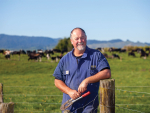
B+LNZ’s Chairman Andrew Morrison says that the announcement gives beef cattle farmers some measure of certainty of what the costs of the phased eradication response will be.
“Our farmers are supportive of the phased eradication response, but one of their areas of concern is not knowing what the cost of their individual contributions to the response would be which will be $17.4 million over the 10 years of the response,” says Morrison.
“Though the final total cost of the phased eradication programme is dependent on a number of factors, having a split agreed by industries means we can now calculate possible levy rates and start consulting with farmers about the practicalities of meeting the beef sector’s share of costs of the response.”
DairyNZ and B+LNZ will consult with farmers in the coming months on how the levies could work.
“Our dairy farmers will hear from us soon on a consultation for a levy to recoup this cost and we encourage all dairy farmers to tell us what they think. We also need to acknowledge the support from the Government and the public for eradication – this has been heartening. The encouraging signs from spring bulk milk testing are showing that eradication looks very achievable,” says van der Poel.
For beef cattle, the contribution will be collected through a separate biosecurity levy at the point of slaughter, in accordance with the proposal B+LNZ put to farmers last year about joining GIA.
The respective boards of DairyNZ and B+LNZ have also agreed to release the details of the recommendation given by the Independent Panel so that farmers can better understand the rationale behind the split. The Independent Panel’s report is available on both the DairyNZ and B+LNZ websites.
The Ministry for Primary Industries’ (MPI) latest situation report on the phased eradication response has the total number of infected properties at 75, with 33 of these being ‘active’ infected properties – where they have yet to be depopulated, cleaned, and have their restrictions lifted.
Results from the spring bulk milk testing are also encouraging, with three quarters of the testing completed and only three farms being confirmed with M. bovis through the milk testing. All three of these properties were already part of MPI’s tracing programme and they all had previously known links to the disease.
Both DairyNZ and Beef + Lamb New Zealand have dedicated sections on their websites to assist farmers who are looking for more information on, or dealing with the impacts of M. bovis.