Widespread support for UAE trade deal done in record time
There's been widespread praise from the primary and business sectors for the Government's speedy negotiation of a trade deal with the United Arab Emirates.
 increase font size
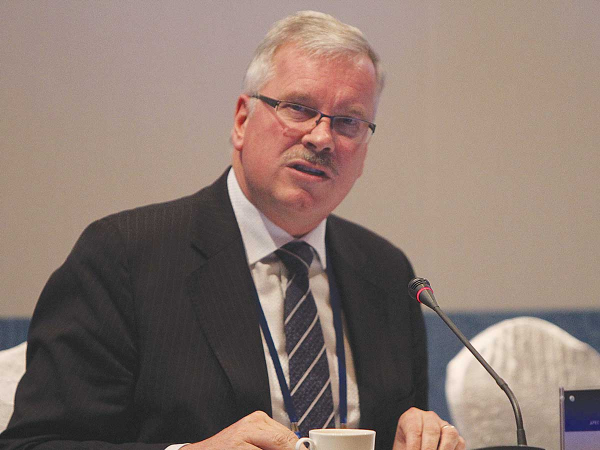 Stephen Jacobi says trade negotiations are successful when they lead to more trade under better trade rules.
Lifting the tempo of trade talks with the United Kingdom is one thing, but it's the final deal that matters most to New Zealand's agricultural sector.
The NZ International Business Forum (NZIBF) says a comprehensive market access package remains the key to unlocking a successful outcome.
"Trade negotiations are successful when they lead to more trade under better trade rules," says NZIBF executive director, Stephen Jacobi.
"That depends on opening markets by eliminating tariffs and non-tariff barriers.
"The work to broaden inclusion and address sustainability and other important issues of mutual interest stems from there."
New Zealand dairy companies also want a UK trade deal that comprehensively removes agricultural tariffs.
Dairy Companies Association of New Zealand (DCANZ) executive director Kimberly Crewther says it understands that the market access offers that the UK has made to date, fall short of the ambitions for the agreement.
"The dichotomy between the UK's political rhetoric and its reported offers for agriculture is deeply disappointing," says Crewther.
This month, Trade and Export Growth Minister Damien O'Connor said that New Zealand and the United Kingdom have agreed to rapidly lift the tempo of talks.
After a meeting with UK Secretary of State for International Trade, Liz Truss, O'Connor says both countries are committed to accelerating the process, with a view to working towards agreemnet in the coming months.
"I also emphasised to Secretary Truss that we still have a significant amount of work to ensure the market access outcomes, particularly for agriculture, reflect the ambition we have jointly set for the FTA - an ambitious, comprehensive deal that removes tariffs," O'Connor said.
Teams will now intensify talks, with chief negotiators meeting monthly and the next formal rounds of talks scheduled for early June and July.
Jacobi acknowledged that good progress had been made in negotiations and there is "plenty of good will" on both sides.
"That good will now needs to be extended to exchanging realistic and commerically meaningful market access offers - including in agriculture," he says. "The UK has thus far not delivered this expectation and needs to do more so the negotiation can move into its final phase."
Dairy exporters are worried of being locked out of any free trade deal DCANZ rejects any suggestion that dairy is a senstive area for this negotiation.
It noted that the UK is one of the world's largest importers of dairy products and these imports largely come from the EU, the world's largest dairy exporter, on duty free terms under the UK-EU bilateral trade agreement.
"At the heart of this negotiation is the question of how the UK chooses to treat New Zealand," says Crewther. "Will it allow New Zealand's dairy community to participate in this trade on a level playing field?
"Will British consumers and food manufacturers be given the same opportunity to choose high-quality New Zealand dairy products, produced under equivalent animal welfare standards and with a lower carbon footprint, as they currently have for EU imports?"
In 2019, the UK imported over half a million tonnes of cheese, almost entirely on duty free terms from the EU. That's a cheese import volume that is 50% larger than New Zealand's total exports to all 82 of its current cheese markets.
Crewther says the importance of tariff removal should not be underestimated in achieving inclusive trade benefits from this agreement.
"Ultimately, it is the tariff disadvantages faced by New Zealand exporters that prevented even 1 gram of the nearly 8kg of cheese the UK imported per person in 2019 being supplied by New Zealand."
There's been widespread praise from the primary and business sectors for the Government's speedy negotiation of a trade deal with the United Arab Emirates.

New Zealand’s free trade agreement (FTA) with the European Union comes into force on May 1, offering differing benefits for different sectors.
A large New Zealand trade delegation is in India this week - but don't expect any major trade deals.
Some horticulture farmers are bracing for financial relief from the proposed free trade agreement between New Zealand and the United Kingdom.
NZ International Business Forum executive director Stephen Jacobi says the present FTA negotiations with the UK is depressing, with the same old roadblocks being put up against NZ as they were some 40 years ago.


Federated Farmers has welcomed new rural policies released by ACT, saying they align closely with its own election priorities.

Rural Contractors NZ says proposed changes to land transport rules for agricultural vehicles are a welcome response by the Government to out of date regulations which have seen members hit with huge fines.
Alliance is calling for final applications for its 2027 Graduate Programme, with applications closing on Sunday 25 October.
Decades piloting planes has ensured vet and farmer David Hayes is focused on safety. So, after a serious accident while welding on farm, he is sharing his experience so others can learn from it.
Canterbury milk processor, Synlait Milk has confirmed Leon Fung as its chief executive officer.
OPINION: Making it easier to collect rainwater and use it to grow crops and livestock is a no brainer.