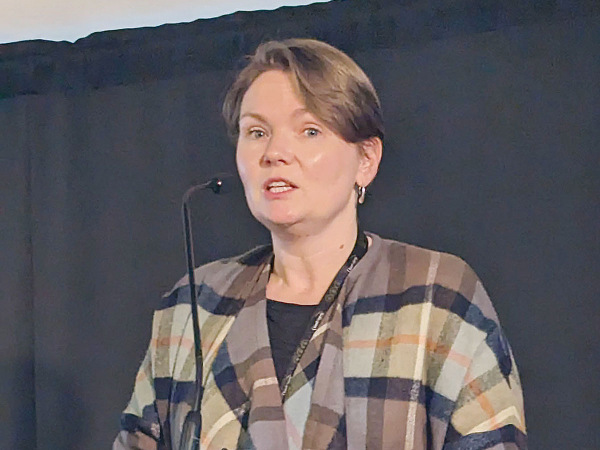
New Zealand must "throw everything we can" at the problem of facial eczema, says Beef + Lamb NZ's sector science strategy manager Dr Suzi Keeling.
Speaking at the recent B+LNZ Genetics Sheep Breeder Forum in Christchurch, Keeling outlined a new seven-year research programme that she hoped would result in new tools for farmers to combat FE.
She said FE was a very old problem for New Zealand, with documented cases well over 100 years ago,
"And it's not getting better. It's spreading."
Keeling told Rural News that FE has historically been more in the North Island but cases were now being seen at the top of the South Island as well.
"Also, with our sheep poo epidemiological study there was almost no part of New Zealand where we didn't find the fungal spoors associated with facial eczema.
"So, it's been gradually moving south."
Keeling says the fungus associated with FE typically likes warm moist environments and with changing climate bringing the conditions that support fungal growth, it was starting to become more of a problem in areas where farmers never had it before.
"So, some of the things that we've done in the last 12 months is starting to build specific workshops tailored to farmers in regions where facial eczema has only become a recent issue for them."
Keeling told the Breeders' Forum that B+LNZ's research team had worked hard to develop a programme involving farmers, breeders and other industry partners. It had finally succeeded in securing government co-funding and was now ready to start communicating more about the project.
"So, it's been a monumental effort to get us this far, and sometimes I almost feel like it's still not quite real."
She hoped to have at least 350 farmers directly involved in gathering data and was already well on the way to that target, with about 200 regularly collecting faeces samples in an epidemiological study conducted over the last facial eczema season.
B+LNZ has earmarked $9 million over the seven years study, MPI was contributing $8.3 million and there would be another $3.4 million in in-kind contributions.
"We've got about 14 industry partners who have all put their hand up to either provide access to field trials, samples, animals, helping us co-develop tools. So, it's impressive."
Keeling said that historically there had been flurries of activity, notably in the 1950s and again in the 1980s, where there was investment in science to tackle FE before "it all kind of stopped".
"What we've now got is the opportunity to take advantage of some of the more modern science approaches and see how we can tackle what is essentially a really old problem for New Zealand."
The first part of the programme would focus on fundamental science, understanding facial eczema and the fungi associated with it.
Keeling said one of the first new insights was that there were multiple species of fungus in pasture, some that produce toxins and some that don't.
"Using that piece of information, our next step is to see if we can come up with a more targeted tool to inform risk on-farm."
They also aimed for a better handle on the social, economic and well-being impacts of FE. Economic cost to the sector was estimated at $332 million dollars a year, while the social impacts were "horrific".
"There's no other words to describe the angst at those farmers feel in knowing that they don't have options, to cure their animals."
Among the aims was a more animal friendly alternative to the Ram- Guard test to identify FE-resistant rams and devising alternative grazing management strategies.
There was a lot of anecdotal evidence about rye grass being a challenge.
“But how do we go further than that and produce some good guidelines and give farmers some options?
“It’s always thinking about what research looks like from a farm systems perspective,” said Keeling.
“It’s the genetics, it’s the feed, it’s the animal health, but it’s also making sure that we’re supporting the farmers on the journey as well and making sure that we’re having really good conversations and listening to all the expertise that’s out there, because we certainly don’t know everything.”