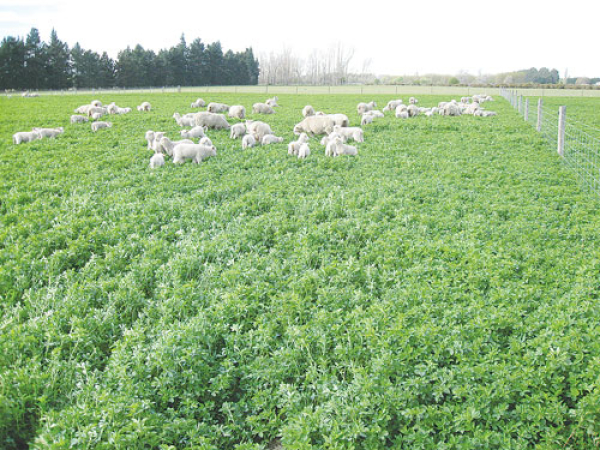
Beef + Lamb New Zealand is reminding farmers with lucerne stands to graze them hard over the next few weeks in preparation for a winter weed control programme.
A weed control programme will help optimise yields in spring, which might be important this coming spring, with El Niño weather conditions predicted.
This weather pattern means lower than average rainfall on the East Coast on both Islands.
Removing Old Growth Improves Spring Performance
A hard graze carried out over May and early June should remove all old stems from earlier rotations and any new regrowth from autumn - without damaging the short basal buds.
The aim is to remove the older stems and get some weeds eaten without eating any newly developing buds.
If there are no new buds (these will be hugging the crown) then removing the canopy of old leaves will stimulate them to be produced. It is those new shoots, produced in May/June, that will elongate rapidly and provide the earliest feed in spring.
The crown of the lucerne plant should never be grazed - ever.
Rainfall Improves Herbicide Effectiveness
Rainfall after grazing is ideal as it removes the dirt, which can deactivate the agrichemicals, from the surface area of the lucerne plant and weeds prior to spraying.
When selecting the agrichemicals to use, factors such as the age of the stand, the weed profile and grazing pressure all need to be taken into account and B+LNZ recommend talking to an agronomist about the best chemicals to use.
Consideration should also be given to grazing withholding periods and applications should be timed so the stand is ready to be grazed in spring.
Common Control Options
Paraquat
This is a fast-acting herbicide which desiccates all plant tissue. It is deactivated when it comes into contact with soil.
Paraquat is the backbone of all winter spray programmes over established lucerne although it is often combined with a suitable triazine.
Paraquat is a knockdown herbicide, but it is not effective enough on its own for weeds with a taproot or rhizomes.
Atrazine
Atrazine has a large weed spectrum of broadleaf weeds and easy to control grasses. It is a good knockdown chemical with moderate residual activity as it has a soil half-life of 35-50 days.
Simazine
Simazine has a soil half-life of 27-102 days but isn’t effective as a knock-down herbicide. It is suitable where there is not a lot of weed cover on lighter soils.
Terbuthylazine
Terbuthylazine is taken up by both the roots and leaves and has a residual soil half-life of 30-60 days. This chemical has a four-week withholding period for grazing. While it is the best triazine to use on catsear, dandelion, storksbill, cocksfoot and grasses, it can affect lucerne so should be applied as early as possible in winter.
Article- B+LNZ