Beef + Lamb New Zealand Awards 2026 Winners Announced in Christchurch
Last night saw the winners of the 2026 Beef + Lamb New Zealand (B+LNZ) Awards named at a gala dinner at Te Pae Christchurch Convention Centre.
 increase font size

THE SUCCESS of the Lincoln and Massey agricultural research hubs will be defined by how much investment they can attract from the private sector – whether multi-nationals or domestic business, says Minister of Economic Development, Steven Joyce.
This country needs $160-$200 billion more invested in export-orientated business if it is to achieve its stated target of growing exports from 30% to 40% of GDP over the next 12 years, Joyce said at the opening of a new Bayer research centre in Auckland.
Domestic investment will not be enough. The sort of investment Bayer is making is important, Joyce says and there are now many international companies wanting to invest.
“If you start with the primary industries, the hubs we are setting up in Lincoln and Massey are designed to attract more international research player into those hubs. I think that will be a definition of their success.
“I have said to those hubs, and to the Waikato one, that my definition of success is not how they rearrange the buildings for themselves – it is how much international or domestic companies they attract in and the mixture between the public and private sector.
“To me that is the definition of success, so it is very early days. We haven’t set any targets on them. We’ve said ‘let’s look at the plans’. The plans need to be much more about that than just rearranging themselves.”
Multinationals and domestic companies are needed. “I was just talking to Bayer about Lincoln and whether it is something that would interest them because we’ve got a high concentration of New Zealand scientists in geographic locations – those two hubs. The opportunity to bring in international research players to bolster that I think is a good plan for New Zealand.”
Earlier Joyce said given our remote location, attracting more companies to build their business in this country is a challenge. To be successful business needed different combinations of about a dozen things: access to a market – a crucial one for New Zealand, access to skilled people, natural resources, capital and the necessary public infrastructure. This was behind the Government’s Business Growth Agenda.
“The reason why companies want to do research here… this country has this amazing ability of people who can cross discipline, who sit there saying ‘we’ve got to be able to solve this problem, let’s work out how we can do it, and let’s make it practical.’
“I personally think it is related to our geography and history: we were isolated down here so we had to make things for ourselves anyway.”
Joyce says he has lost count of the number of overseas people who comment on our ability to innovate. “That’s something we’ve got to hang on to – develop our innovation and skills base here.”
The Government had just reorganised its R&D co-funding into three more straight-forward approaches.
R&D growth: open to all players including international
R&D projects grants: for the more ‘out there’, less immediately commercial R&D
R&D student grants: to get more graduates and undergraduates into business, so they can get straightforward interface.
This country is getting more postgraduates but they could not all go into academia; a good mix of them needed to go straight out into industry, says Joyce.
Last night saw the winners of the 2026 Beef + Lamb New Zealand (B+LNZ) Awards named at a gala dinner at Te Pae Christchurch Convention Centre.
A significant breakthrough in understanding facial eczema (FE) in livestock brings New Zealand closer to reducing the disease’s devastating impact on farmers, animals, and rural communities.
A breakthrough in the understanding of Facial Eczema (FE) in livestock could bring New Zealand closer to reducing the disease’s impact.
An innovative idea for transforming mechanically deboned meat (MDM) into a meat flake for seasoning has taken top honours in the Meat Industry Association’s (MIA) first-ever Dragon’s Den competition.
The Government's plan to merge the seven crown institutes presents exciting possibilities for plant technology company Grasslanz Technology, says chief executive Megan Skiffington.

Federated Farmers says it welcomes Labour's commitment to reviewing the Sharemilking Agreements Act, calling on other major parties to do the same.
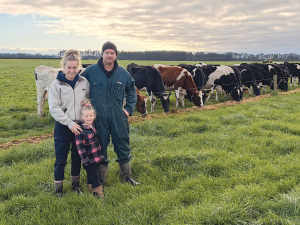
For Canterbury dairy farmers Sian Meijer and Rick Wobben, wearable technology has become one of their most valuable on-farm tools - helping manage 1850 cows across an expansive, high-performing dairy operation while improving efficiency, mating outcomes and day-to-day decision making.
Fonterra has unveiled its annual results for the 2026 financial year, posting $27 billion in revenue and close to $20 billion returned to New Zealand farmer owners and unit holders.
The first major update to the Dairy Cattle Code of Welfare in more than a decade has been released, marking what DairyNZ describes as an important step in ensuring animal welfare standards continue to evolve alongside scientific evidence and on-farm realities.
Ravensdown shareholders have elected Jane Montgomery and Kate Acland to the Ravensdown Board for three-year terms, following a closely contested director election.
Federated Farmers says new legislation replacing the Resource Management Act will cut red tape, unlock investment and help grow New Zealand's export-led economy, after the Planning Bill and Natural Environment Bill passed their third reading in Parliament yesterday.