NZKGI Responds to Migrant Worker Exploitation Reports
Where any worker in the kiwifruit industry is mistreated, we expect the authorities to take action.
 increase font size
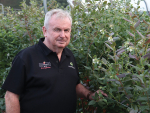
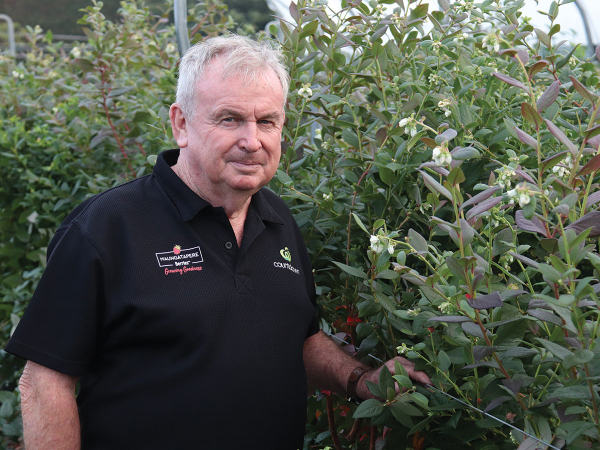 Dermott Malley believes blueberries have the potential to become a major export, earning up to $150 million within the next three to five years.
Blueberries have the potential to become a major horticultural export, earning up to $150 million within the next three to five years.
That's the view of Dermott Malley who, along with his family, have been growing berryfruit and kiwifruit near the Northland township of Maungatapere, just west of Whangarei, for over ten years. Malley is also a member of the HortNZ board.
While he has stepped down from the day-to-day running of Maungatapere Berries, now run by his son Patrick and wife Rebecca, Malley is still involved in the business.
Right up until 2019, the focus of Maungatapere Berries was on brambles or soft berries - six hectares were in raspberries and blackberries and four hectares in blueberries.
They did and still have some green and gold kiwifruit as part of their overall business and are looking at some of the new Zespri varieties which grow well in the warmer climate of Northland.
When Patrick, as part of a succession plan, took over the business, they shifted the focus to blueberries, and away from the brambles, continuing to growing these hydroponically and under cover.
Doing this has several advantages. One of these, he says, is speed, because with hydroponics undercover they can get a new variety of blueberry into production within a year as opposed to three to five years in the field, depending on the variety
He says it also means they can produce berries right through the year and are not confined by the limited outdoor growing envelope.
"The second reason is the varietal range becomes quite different. Several of the more modern varieties, particularly Southern Highbush which have nice-sized beautiful tasting fruit, are quite susceptible to some of the pests and diseases if you grew them outside.
"So, growing them undercover means we can manage the crop better, improve its consistency, size and amount of fruit produced. We can also improve the taste of the fruit, have less wastage and ensure the best product is available to go onto the supermarket shelves," he says.
A key driver in changing to growing blueberries hydroponically and undercover at Maungatapere Berries has been a focus on future profitability and looking for new overseas markets.
Increasing the amount of fruit each plant produces is an important part of this equation.
Pruning is the main way of doing this by getting each plant to grow more stems and thus more flowers that produce the fruit. This incidentally is the same in the kiwifruit industry.
It's a simple piece of maths, says Malley.
"The more flowers we have, the more fruit we have, and with that is higher productivity per hectare. However, Patrick has a unique focus on productivity, which is per metre, because we hand pick and the less distance you have to walk to fill a tote of fruit makes you more efficient," he says.
Having blueberries undercover has allowed the Malleys to grow this amazing fruit all the year round.
It has also enabled them to grow some varieties which cannot be grown easily outdoors.
"To the best of my knowledge, blueberries now grow 12 months of the year and we will put them through our own packhouse. With our new varieties, we will harvest all the way through until November, so that gives us access to the domestic market and also interestingly to the markets in Southeast Asia," says Dermott Malley.
A large part of their crop is sold in NZ, while 90% of all New Zealand blueberries exported go to Australia. But by being able to produce their fruit 12 months of the year, the Malleys are looking to export to Southeast Asia, including Japan, Vietnam, South Korea and Taiwan - where incidentally they do not face any tariffs.
With profitability front and centre of their operations, the next innovation is likely to be mechanical harvesting.
Already the Malleys are preparing for this by spacing trees in such a way that a mechanical harvester can be deployed.
At the same time, they are looking at new and better varieties of blueberries that can be mechanically harvested.
There is a huge cost saving to using mechanical harvesting, according to Malley.
"It costs somewhere between $6.50 and $8.50 to hand harvest but just 80c/kg to mechanically harvest. But in doing this, special equipment has to be used to prevent any damage to the fruit," he says.
With the strides he and his family have made in the growing of blueberries, Malley sees a very bright future.
At present, New Zealand blueberry exports bring in less than $45 million annually, but he is confident that within three to five years this could be around $150 million.
"Blueberries are recognised the world over as a superfood. It's good for the liver, helps with cancer and Alzheimers and is extremely beneficial to the human digestive system. We hardly need to market this fact, all we have to do is supply the markets," says Malley.
Where any worker in the kiwifruit industry is mistreated, we expect the authorities to take action.

Kiwifruit growers are watchful but remain optimistic as concerns around the potential effects of the El Niño weather pattern this season.
More signs of a booming kiwifruit sector.
James Blair, an agronomist for AS Wilcox and the Pukekohe regional champion, has won the 2026 Young Grower national title.
After delivering a strong financial year, rural trader PGG Wrightson says the coming months will depend on customer confidence and weather.


OPINION: There could hardly be a more appropriate theme for a conference than the one chosen by the red meat sector - Navigating Volatility.
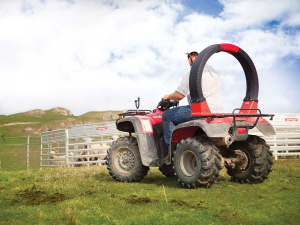
When Northland leather worker Vernon Suckling started making horse saddles 50 years ago, quad bikes and side-by-side vehicles were unheard of.
Alliance Group has confirmed that eligible farmer-shareholders who supply and continue to back the business will receive up to $20 million later this year, following the strategic investment partnership with Dawn Meats.
With a general election under five weeks away, Rural News is asking major political parties about their policies and positions on key issues facing the primary sector. We will run their responses to each question over the next four weeks. The ACT Party and the Greens didn't respond in time.
The red meat sector is in great heart.
Entries opened on Monday, 5 October 2026 for the 2027 New Zealand Dairy Industry Awards (NZDIA), which organisers describe as the nation's biggest celebration of excellence in the dairy sector.