Beef + Lamb New Zealand Awards 2026 Winners Announced in Christchurch
Last night saw the winners of the 2026 Beef + Lamb New Zealand (B+LNZ) Awards named at a gala dinner at Te Pae Christchurch Convention Centre.
 increase font size
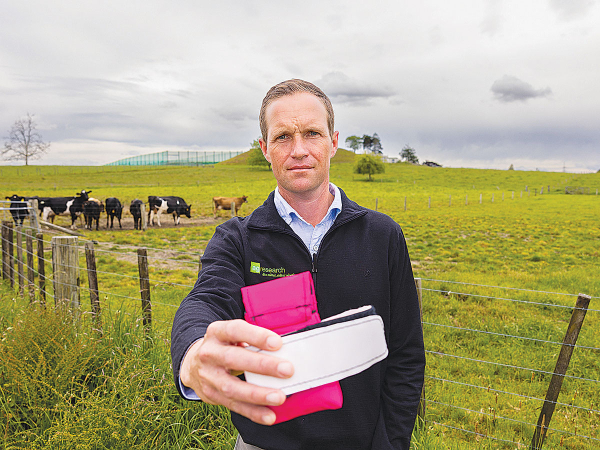 AgResearch senior scientist Brendon Welten holding a urine sensor.
It's a wee issue but with a big environmental impact, and a new award-winning technology developed by AgResearch may help farmers to address it.
Scientists at the research institute have developed what they call acoustic urine sensors to tackle the problem of nitrogen loss from the urine of cattle, which affects water quality and leads to emissions of nitrous oxide, a potent greenhouse gas.
The device attaches to the rear leg of dairy cattle to enable recording and identification of distinct sound patterns in "urination events", including timing and volume. Data from the recordings is analysed using technologies that include machine learning.
Dairy cows typically urinate 10-12 times per day with an average urination volume of two litres per event and an average equivalent urinary nitrogen application rate estimated to be approximately 600kg of N/ha.
"Our research has shown that the nitrogen load of an individual urination event is closely connected with daily urination frequency, the time of day and the volume of the urination event," says AgResearch senior scientist Brendon Welton.
"This means that urination frequency and volume per event directly affect the amount of nitrogen deposited in urine patches on the pasture. Therefore, cows that urinate more frequently per day coupled with a lower volume per urination event tend to excrete lower risk to the environment."
This knowledge has led to AgResearch developing the concept of an environmental nitrogen herd test to identify and manage cows based on urinary-nitrogen loss potential.
The concept is similar to routine herd testing for milk quality and production; with a service provider developing the urine sensor technology on a dairy farm to provide an accurate estimate of an individual cow's urination frequency and volume per event. This informs the urinary nitrogen loss potential of individual cows in the dairy herd.
"Once farmers have this farm-specific urinary nitrogen loss information of their dairy herd, this could be used in a decision support tool like Overseer to allow potential immediate benefits in reducing farm nitrogen loss relative to using a default model value.
"Furthermore, farmers can then use it to make farm management decisions, such as breeding and culling, to move their dairy herd towards lower nitrogen loss potential and thereby provides the opportunity to achieve sustained reductions (year on year) in farm nitrogen leaching loss."
Last month, the research behind the sensor development was recognised when AgResearch's Cattle Urine Sensor team won the Science and Technology Award at the 2023 Kudos Awards in Hamilton.
"It's fantastic to have that recognition given over five years of development," Welten says.
"The benefits of these sensors are that they are lightweight, simple to use and low-cost. Their use can be easily scaled up and requires no capital investment in farm infrastructure, with minimal effect on daily farm management practices.
"Our current research is assessing farm-level benefits of this concept on farm nitrogen loss using case-study dairy farms linked with modelling funded by the Ministry for Primary Industries. We are looking forward to the potential large-scale adoption of this concept in the future by New Zealand dairy farmers as a new tool to mitigate farm nitrogen loss."
Last night saw the winners of the 2026 Beef + Lamb New Zealand (B+LNZ) Awards named at a gala dinner at Te Pae Christchurch Convention Centre.
A significant breakthrough in understanding facial eczema (FE) in livestock brings New Zealand closer to reducing the disease’s devastating impact on farmers, animals, and rural communities.
A breakthrough in the understanding of Facial Eczema (FE) in livestock could bring New Zealand closer to reducing the disease’s impact.
An innovative idea for transforming mechanically deboned meat (MDM) into a meat flake for seasoning has taken top honours in the Meat Industry Association’s (MIA) first-ever Dragon’s Den competition.
The Government's plan to merge the seven crown institutes presents exciting possibilities for plant technology company Grasslanz Technology, says chief executive Megan Skiffington.


Federated Farmers has welcomed new rural policies released by ACT, saying they align closely with its own election priorities.

Rural Contractors NZ says proposed changes to land transport rules for agricultural vehicles are a welcome response by the Government to out of date regulations which have seen members hit with huge fines.
Alliance is calling for final applications for its 2027 Graduate Programme, with applications closing on Sunday 25 October.
Decades piloting planes has ensured vet and farmer David Hayes is focused on safety. So, after a serious accident while welding on farm, he is sharing his experience so others can learn from it.
Canterbury milk processor, Synlait Milk has confirmed Leon Fung as its chief executive officer.
OPINION: Making it easier to collect rainwater and use it to grow crops and livestock is a no brainer.