Pigtail standards made to last
Feedback from farmers highlighted frustration at the time and cost involved in frequently replacing failed pigtail posts.
 increase font size
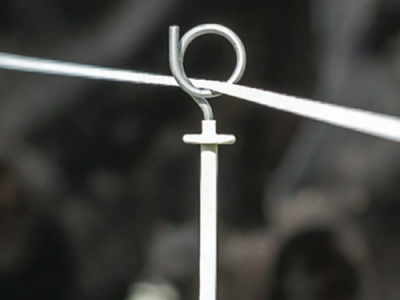 Tangle Free Hotpost.
Research and development by Strainrite has resulted in the company's Tangle Free Hotpost.
Primarily used to hold a herd of cattle in a break-feed crop, the shaft of the pigtail stake is electrified using an insulator just above ground level instead of at the pigtail end, which helps deter more boisterous bovines from pushing over the fence to get to the rest of the crop.
Ease of use is ensured by an insulated hand grip just below the pigtail – none of the protruding handle seen in the previous design – which helps reduce the tendency of shafts to tangle.
The shaft of the Hotpost is manufactured from high strength, bend resistant galvanised spring steel, and uses the galvanised steel foot proven on the company's popular gold foot post; it is said to offer superior strength and excellent ground holding characteristics.
The new post also has an integral, formed spring steel pigtail that carries no risk of poly-wire or tape cutting through plastic coatings and causing electrical shorts.
Dairy farmer Alf Teasdale, who has used the posts with conventional pigtail standards for years, comments "getting supplementary feeding wrong can be disastrous to a cow's health, but these new standards reduce the potential for breakouts and are quickly respected by stock".
Feedback from farmers highlighted frustration at the time and cost involved in frequently replacing failed pigtail posts.
New Zealand engineering firm Strainrite has been manufacturing its own pigtail standards for many decades, working closely with farmers to design and produce standards that are free of the faults farmers say are often found in cheaper, imported brand.
Several years ago, Strainrite's Southland rep identified a gap in the market for quality multi-wire break feeding products for sheep and beef farmers.
Fencing specialist Strainrite has expanded its range of electric fence energisers.
Strainrite fencing Systems says it has developed the Joule Shield wooden post claw insulator to address the limitations inherent in older insulators.



LIC shareholders have elected a new North Island representative to the co-operative's Board, along with five representatives to its Shareholder Reference Group (SRG), following the company's Annual Meeting held in Invercargill.
Farmers across parts of Southland and South Otago are continuing to deal with difficult conditions after a prolonged run of wet weather, with pressure building around feed supply, stock management, pasture damage, farm infrastructure and everyday workloads.
Federated Farmers says it welcomes Labour's commitment to reviewing the Sharemilking Agreements Act, calling on other major parties to do the same.
For Canterbury dairy farmers Sian Meijer and Rick Wobben, wearable technology has become one of their most valuable on-farm tools - helping manage 1850 cows across an expansive, high-performing dairy operation while improving efficiency, mating outcomes and day-to-day decision making.
Fonterra has unveiled its annual results for the 2026 financial year, posting $27 billion in revenue and close to $20 billion returned to New Zealand farmer owners and unit holders.
The first major update to the Dairy Cattle Code of Welfare in more than a decade has been released, marking what DairyNZ describes as an important step in ensuring animal welfare standards continue to evolve alongside scientific evidence and on-farm realities.