Kuhn Group Sales Dip 9% in 2025 but Orders Signal Recovery
Kuhn Group recorded net sales of NZ$2.27 billion in 2025, finishing around 9% lower than in 2024.
 increase font size
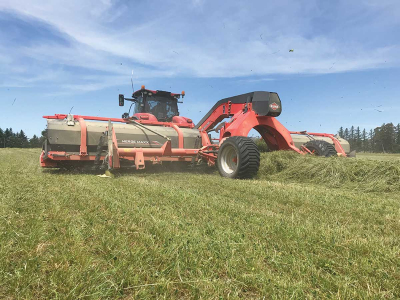 Merge Maxx 950.
Belt mergers are known for their clean forage pick up and handling, the KUHN Merge Maxx 950 is no exception.
This is a highly versatile machine capable of gently gathering any kind of forage and retaining its maximum feed value. Having been demonstrated throughout New Zealand over the last two harvest seasons, the Merge Maxx 950 has reinforced the reputation for belt mergers to deliver clean forage pick up and handling in all crops including lucerne, grass, whole crop barley and pea straw.
An ability to gently handle all crops – with minimal forage pollution, leaf spoiling and ground contact – sets the Merge Maxx 950 apart from the conventional rotor and ‘V’ type rakes. It uses two independent pick-ups to offer total raking width of 7.5m in “side delivery” mode and up to 9.5m in “central windrow” position.
With eight different forage delivery options, the machine is suited to all conditions – from raking two separate 3.5m swaths for conventional hay baling, through to grouping 20m or even 30m of forage into large swaths for today’s high horsepower forage harvesters.
Clever design uses the AT10 controller, which allows any operator to master the controls easily. It also gives the ability to alter windrow delivery, direction of the belts, setting into work mode and a useful hour counter for jobs.
Belt speeds can be individually adjusted by using a hydraulic flow limiter, while raking height can be adjusted via crank handle at the rear of each pick-up bed. Tool-less belt tension adjustment makes day-to-day maintenance a breeze.
Key advantages of the Merge Maxx 950, delivered by the ability to merge up to 30m of lighter crops into one swath, means more efficient harvesting, allows harvesters and trucks to travel at lower speeds – yet keeping the chopping drum full.
Additional benefits means fewer swathes to collect in ease paddock means fewer wheeling’s and compaction damage and less kilometres travelled during a working day.
Visit site no. 345 at Southern Field Days.
Kuhn Group recorded net sales of NZ$2.27 billion in 2025, finishing around 9% lower than in 2024.
ZED, the dedicated wholesale division of CB Norwood Distributors, and the importer and distributor for Kuhn in New Zealand, has announced investment in local expertise and stock availability for customers in 2026.
Kuhn has announced an expansion of its range of disc mowers, distributed by Norwood in New Zealand, with the addition of two new vertically folding rear mounted models, the GMD 3515 and GMD 4015.
With most forage harvester manufacturers offering machines touching 1000hp, the logistics puzzle has always been ‘dropping” grass and pulling into a swath big enough to feed the “beast”.
French company KUHN has won a EIMA Technical Innovation Award for its Baler Automation Technology.


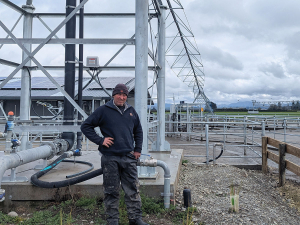
Converting a longstanding cropping farm to dairy was the only way to ensure the land stayed in the family long term, says new dairy farmer Rod May.

As the election heats up, Organics Aotearoa New Zealand (OANZ) has launched its election scorecard designed to help voters wanting to support policies that grow organic and New Zealand's organic sector.
A 'tsunami' of milk from key exporting countries is winding down and this may be good news for New Zealand dairy farmers.
Will the good times last? That's one of the key issues to come out of the latest Federated Farmers confidence survey.
Outgoing Fonterra Co-operative Council chair John Stevenson says that it has been a privilege to represent the co-op's farmer shareholders.
Have a plan in place for your cows and staff.