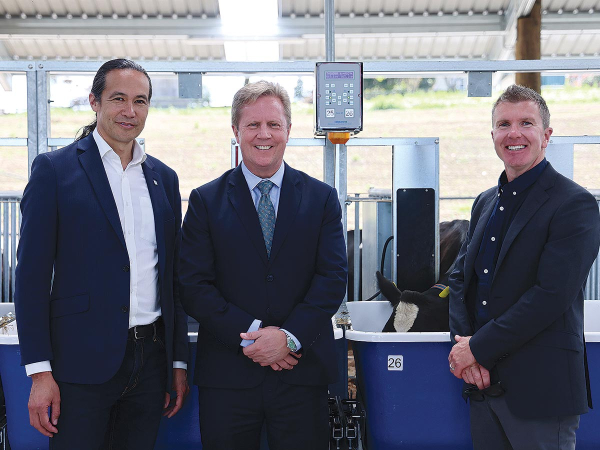
Opening a new $3 million methane research barn in Waikato this month, Agriculture Minister Todd McClay called on the dairy sector to “go as fast as you can and prove the concepts”.
The message was directed to LIC and its partners behind the next stage of methane research.
Situated at LIC’s Innovation Farm at Ohaupo, the barn is part of the co-op’s ongoing efforts to breed climate-friendly cows and reduce New Zealand’s agricultural emissions. Supporting LIC are Ministry for Primary Industries (MPI), Ag Emissions Centre, CRV and state-owned farmer Pamu (Landcorp).
McClay told guests at the opening that Government’s happy to provide financial support to such projects.
“We are doing so not just because we like you and have great faith in you: we are investing taxpayers’ money in the future of New Zealand farmers,” he says.
“I ask only one thing - go as fast as you can and prove the concepts as quickly as you can and then help us commercialise and then roll them out very quickly, because our farmers need it.
“The world is watching, and we do absolutely can reduce farm emissions and increase production.
Read More:
“If we can do that then we’re doing not only a great favour for every New Zealander through growth of the economy, we are actually doing more than our fair share when it comes to meeting the commitments the world has made of net zero by 2050.”
The opening of the barn is timely. Earlier this month, the Government announced its new methane reduction targets. It has revised its 2050 biogenic methane target to a 14–24% reduction below 2017 levels, a significant decrease from the previous 24–47% range.
McClay says the revised target follows two years of engagement, consultation and consideration of science.
“We sought advice broadly within New Zealand and through the independent scientific review we undertook, and equally from people who are from around the world.
“We took our obligation very seriously to get the target right so that New Zealand not only remains committed to meet its commitment under the Paris climate change agreement but also do it in such a way that we can ensure that New Zealand farmers can continue to produce the high-quality, safe food.”
He pointed out that all New Zealand farmers are some of the most carbon efficient food producers in the world.
If NZ farmers were forced to produce less through closure of farms, global consumers would source their food from the US or the EU.
“They will produce it and produce more emissions when they do, so the climate will be worse off, and we’ll be poorer.
“So, I took a position with our Prime Minister Christopher Luxon that New Zealand farmers and agri-tech is not the problem, they are part of New Zealand’s solution and the world’s solution to finding ways to meet this commitment of reduced emissions from agriculture methane.”