
Ravensdown Elects Montgomery, Acland to Board
Ravensdown shareholders have elected Jane Montgomery and Kate Acland to the Ravensdown Board for three-year terms, following a closely contested director election.
 increase font size
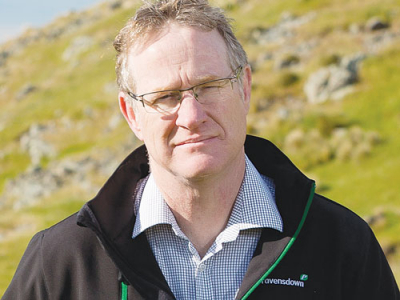 Michael White, Ravensdown.
More precise aerial fertiliser spreading has already proven to give greater environmental gains than blanket topdressing, says fertiliser company Ravensdown.
But new research will further improve the productivity of New Zealand’s hill country farmers, the company says.
Presenting their findings at the 30th Annual Fertiliser Lime and Research Workshop recently, Michael White, Ravensdown development manager, and Dr Ants Roberts, chief scientific officer, outlined results from 40 commercial fertiliser applications that have used the variable rate technology.
“On the 40 farms an average of 9% of the land has either been environmentally sensitive or non-productive, which is well above what we expected. Being able to avoid such land during fertiliser application brings environmental gains and may save money,” says White.
“In fert spreading precision, pilots and aerial spreading operators have for years done the best they can with the technology they had.
“Only now are technology developments emerging that allow hill country farmers to begin to pick and choose where to apply, or not apply, their fertiliser. If of sufficient size, a stream, some scrub or a sacred site can be mapped and avoided more easily, cost effectively and safely,” says White.
Using AgResearch’s PKS lime econometric model, they then compared a variable rate application to a blanket fertiliser strategy on four farm-modelled scenarios. Farm economist Phil Journeaux reviewed and supplied the Overseer nutrient budgets and productivity weightings.
“What we have found over the four econometric scenarios we analysed is that within 10 years all farms were more profitable using the variable rate fertiliser strategy,” says White.
“On average, the farm scenarios were $43/ha better off in that timeframe than they would have been using a blanket spreading strategy for a typical North and South Island farm. It also proved more sustainable, when tested against volatile returns for farm profitability over the ten years.”
The variable rate spreading technology is an ancillary programme funded by Ravensdown in support of its joint Primary Growth Partnership programme with the Ministry for Primary Industries -- called Pioneering to Precision, which is aiming to develop aerial soil testing technology using hyperspectral imagery.
Now in year four of its seven-year programme, Ravensdown is identifying considerable productivity potential between differing land management units on hill country farms.
“It’s important that our research is going to be economically viable for it to be adopted by farmers. What this research proves is that farmers can have confidence in the technology right now, in its early stages, knowing all the while that further technological advancements in GPS guidance and automation will allow greater efficiencies and effectiveness down the line.”
Ravensdown shareholders have elected Jane Montgomery and Kate Acland to the Ravensdown Board for three-year terms, following a closely contested director election.

OPINION: It appears to be difficult for people who haven’t tried to run a business to understand the difference between assets and cash.
Testing confirms H5 bird flu in a single northern giant petrel, found dead on a remote Cape Palliser beach in the Wairarapa, says Dr Mary van Andel, the Ministry for Primary Industries' (MPI) Chief Veterinary Officer.
OPINION: In the 1980s, concern was expressed in West Germany about the falling birth rate. Some simple analysis was performed by Professor Helmut Sies, physician and biochemist at Dusseldorf University. His letter ‘A new parameter for sex education’ was published in Nature in 1988:
The apple sector is working with the Government to unlock access to two key markets that could bring millions in revenue for apple growers.



Federated Farmers has welcomed new rural policies released by ACT, saying they align closely with its own election priorities.

Rural Contractors NZ says proposed changes to land transport rules for agricultural vehicles are a welcome response by the Government to out of date regulations which have seen members hit with huge fines.
Alliance is calling for final applications for its 2027 Graduate Programme, with applications closing on Sunday 25 October.
Decades piloting planes has ensured vet and farmer David Hayes is focused on safety. So, after a serious accident while welding on farm, he is sharing his experience so others can learn from it.
Canterbury milk processor, Synlait Milk has confirmed Leon Fung as its chief executive officer.
OPINION: Making it easier to collect rainwater and use it to grow crops and livestock is a no brainer.




