Milk Powder Prices Prop Up Farmgate Milk Price
Milk powder prices are keeping farmgate prices up, helping processors offset the dip in milk fat prices.
 increase font size
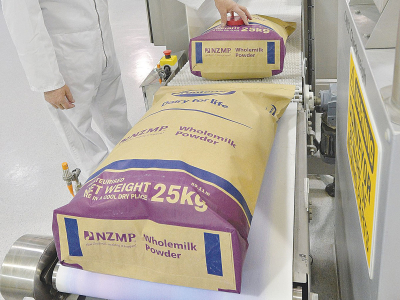 Whole milk powder prices rose 3.6%.
The 2.7% jump in last week’s Global Dairy Trade overall price index – with a 3.6% bounce in whole milk powder – was a surprise, economists agree.
All eyes will be on China demand and New Zealand spring production in the coming months.
The theme of tight milk supply from the main exporting regions is still an underlying factor, says RaboResearch dairy analyst Emma Higgins.
Whole milk powder (WMP) average price nudged over the $US3000/t mark. Skim milk powder (SMP) prices also saw a 3.8% rise, lifting the average price to $US2505/t.
Higgins told Dairy News these were pleasing – and surprising – results for this time of year, held up by robust Southeast Asia demand.
“We have seen extraordinary volumes shipped from New Zealand to China over recent months,” she says.
“NZ exports to China for the last three months have been at record levels.”
But it seems clear there is stock building in China, based on RaboResearch modelling.
“Based on the prolific Chinese import volumes in 2019 to date, we anticipate some price weakness to eventuate over the coming months as inventory pipelines recalibrate over the short term.”
Westpac senior economist Anne Boniface says this was the first lift in WMP prices since March. Smaller improvements occurred in fats prices.
“Global growth in milk supply is still expected to be relatively modest over the second half of this year,” she says.
“While much will depend on pasture conditions in NZ, it’s unlikely that last year’s exceptionally strong growth in milk production during spring will be repeated.
“And with the national herd likely to be static, or even contract a little, further growth in the national milk supply will hinge on incremental productivity improvements.
“Buying from the North Asia region (dominated by China) has been strong through the first half of the year. Most recently, the proportion of GDT sales to the North Asia region has been notably higher than usual through June and July.
“This suggests that consumer demand for dairy products in China seems to be holding up well, despite growing headwinds for the Chinese economy and trade tensions.”
While last week’s GDT was a little stronger than they had pencilled in, Westpac is holding its $6.90/kgMS forecast for the current season.
ASB rural economist Nathan Penny says last week’s results were better than the bank’s expectation of no change and better than futures market pricing, which indicated a circa 1% rise.
WMP prices still remain about 7% lower than their 2019 highs, with the six auctions during April, May and June all posting falls. SMP prices led price gains last week and milk fat prices stabilised after recent large falls, with butter and anhydrous milk fat prices increasing 1.7% overnight.
“In our view, this result does not change the outlook for global dairy markets,” says Penny. “The result, if anything, is a function of prior price weakness rather than a signal of renewed price strength. With this in mind, we continue to see global dairy markets, as on the whole, tight.”
ASB is holding its forecast at $7/kgMS, but so early in the season that it comes with a wide range of error of $1/kgMS each way.
Milk powder prices are keeping farmgate prices up, helping processors offset the dip in milk fat prices.

OPINION: With 10,500 dairy farms, New Zealand continues to punch above its weight around the world.
A milk glut around the world shows no sign of easing, putting downward pressure on farmgate milk prices for the next few months.
Fonterra has reduced its forecast 2026/27 Farmgate Milk Price.
New Zealand dairy farmers are set to be the first in the world to receive access to a new digital physical milk pricing tool that enables them to fix the price for their physical milk.



National’s much-touted free trade deal with India featured in the Rural Issues Debate at Mystery Creek, Hamilton on Wednesday night.

New Zealand's 2026-27 freshwater fishing season has opened, with anglers encouraged to head to rivers and lakes over the coming days as conditions look favourable across much of the country.
Central Otago District Council (CODC) has voted against a plan to spread treated sewage sludge from Cromwell and Alexandra on farmland near Lauder, a decision Federated Farmers says reflects strong opposition from rural residents.
Pāmu has released its FY26 Integrated Annual Report, reporting a Net Operating Profit of $113 million, more than double the $49 million recorded in FY25.
Meat Industry Association data, released alongside the Red Meat Sector conference in Wellington, shows export value climbing across the US, China, UK and Canada.
Applications are set to open for the 2027 Zanda McDonald Award, a trans-Tasman award recognised for identifying and fast-tracking talented young leaders in agriculture and agribusiness.