Resilient Global Dairy Industry Overcoming Volatility
Fonterra chief executive, Richard Allen says being resilient has helped the dairy industry overcome extreme volatility in recent years.
 increase font size
 Fonterra director of sustainability Charlotte Rutherford.
Fonterra says it remains on track to meet its climate targets and be coal free in its North Island manufacturing.
Last month, the cooperative turned off the coal boiler at its Waitoa site, marking a significant milestone in achieving its emissions reduction targets outlined in its Climate Roadmap released in November 2023.
Fonterra director of sustainability Charlotte Rutherford says the Climate Roadmap is central to guiding Fonterra’s journey toward achieving its near-term climate targets and ambition to be net zero by 2050.
“We’ve made a great start. While progress may not be linear, we are on track to meet these targets. I’m particularly proud of the work the team has done to achieve SBTi validation, the progress in providing tools and services for farmers, and the efforts of decarbonising our manufacturing sites,” says Rutherford.
“While it may be one year on from the release of our Roadmap, we have been focused on reducing our emissions, particularly from our manufacturing and operations, for some time now and being free of coal in our North Island manufacturing is something the team should be proud of.”
This year alone, three renewable energy projects at Edendale, Hautapu, and Clandeboye have reduced emissions by a total of 62,500 tonnes, equivalent to taking 27,750 cars off the road.
Rutherford says just as important has been the work over the past year to lay the foundations to support farmers in reducing their emissions.
“Reducing emissions through driving greater on-farm efficiencies is also a priority for the co-op. Our approach is about empowering farmers with tools, insights and support to make meaningful changes.
“Over the past 12 months our farmer facing teams have been working on a range of tools and services for farmers, including targeted conversations to understand what the future may look like, and mapping tools that will help identify woody vegetation for carbon sequestration.
“As we move closer to 2030 we will begin to see the impact of these tools and services in the results. We know there’s more work to be done, and right across the value chain we continue to invest in innovative technologies and solutions that will set us up for success.”
Helping Farmers
Fonterra chief executive, Richard Allen says being resilient has helped the dairy industry overcome extreme volatility in recent years.

Northland farmer Greg Collins has taken over as chair of the Fonterra Co-operative Council.
Fonterra’s 2026 financial year was a year of delivery, with record volumes of milk collected, processed and shipped by the co-op.
Dairy farmers, still holding onto their Fonterra shares despite switching milk supply elsewhere or exiting the industry, now face a stricter share sell-down requirement.
Milk powder prices are continuing their merry run, firming up a potential $10/kgMS farmgate price this season.

During the nesting season, from September to December, industrious starlings can quickly build nests in the darker areas behind tractor and vehicle, usually close to hot engines, typically resulting in localised damage or in some cases complete write-offs.
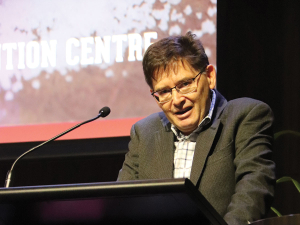
The meat processing industry is much more collegial than it was in the past and is now more focused on common goals.
With the last couple of months having seen some potential tractor purchases put on hold with the impending election and continued input cost rises, year-to-date figures, ending September, has seen deliveries up around 5% over the same period in 2025, with a total of 2026 units.
Beef+Lamb New Zealand is calling for nominations for director roles in the Northern South Island and Northern North Island electoral districts.
Fonterra chief executive, Richard Allen says being resilient has helped the dairy industry overcome extreme volatility in recent years.
The head of the Ministry for Primary Industries (MPI) trade and international relations group says New Zealand is well-positioned to secure trade access and compete internationally as the world becomes more complicated, demanding and uncertain.