India FTA Unites NZ First, Greens
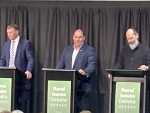
National’s much-touted free trade deal with India featured in the Rural Issues Debate at Mystery Creek, Hamilton on Wednesday night.
 increase font size
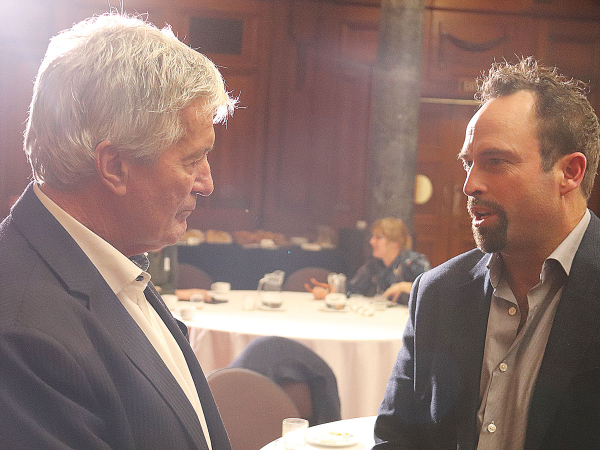 Former Ag Minister Damien O’Connor and Federated Farmers board member Richard McIntyre at Parliament.
Federated Farmers have reiterated their support for the coalition Government to abolish the present ban on the live export of animals.
Board member and dairy farmer Richard McIntyre says they support the reintroduction of live exports, with the proviso that the welfare of the animals can be assured. His comments came after he attended a recent function at Parliament, following the presentation of a 50,000-signature petition by animal welfare lobbyists to keep the ban.
The function was hosted by former agriculture minister Damien O'Connor and Green MP Steve Abel, along with Dr John Hellstrom, who organised the petition. There was also a wide range of animal welfare groups represented, including the SPCA and three overseas experts on the subject.
These included Australian 'whistle-blower' veterinarian Dr Lynn Simpson who worked for ten years as a vet on ships carrying sheep and cattle from Australia to a range of destinations around the world. At Parliament she gave a graphic presentation showing photographs of some of the conditions she encountered. "Hell on the high seas, floating ovens and coffins" was how she described it.
"No voyage was a good voyage and there was no gold standard," she says.
McIntyre, who sat through the presentation, noted that most of the ships were out of Australia, but he agreed that if the same things had happened on an NZ ship, they would have looked more closely at the situation. He says he's spoken to NZ vets who have been on such voyages and who have told him the care of animals has been good.
McIntyre says the frustration that Feds had with the previous government was that they introduced the ban on live exports without investigating ways to improve the care of animals on such trips and meeting the concerns of the animal welfare lobby. He says they also failed to consult properly and instead just slapped on the ban. "We are pleased that this Government is having a really good look at it and seeing what can be done to improve the practice and therefore alleviate animal welfare concerns," he told Dairy News.
McIntyre says some of the images shown by Simpson were of injuries suffered by animals on the voyages, but he says injuries like these can occur on any farm at any time. However, many of injuries shown by Simpson featured animals living in their own excrement.
"None of us who saw those photos would find that acceptable. We all care about animal welfare, we don't want to be sending our animals away to suffer."
Credible Critic
Dr Lynn Simpson is arguably one of the more credible critics of the live export trade. She made her first trip as a vet on a livestock carrier in 2001 and went on to complete a total of 57 trips going to all parts of the world including the Middle East, Turkey, Libya, Egypt and Russia.
Right from her first trip, just after graduating as a vet, she voiced her concerns about what she was seeing. She says while you have these concerns, they soon disappear when you arrive at the destination, have a shower, change into clean clothes and fly back home. Simpson says at that point you have no control of the animals you have looked after on the trip.
But the reality of working daily on a livestock carrier was a long way from what the average vet encounters at their practice.
"It was the veterinarian's equivalent of being in a war zone. Trying to treat injured and stressed animals in appalling conditions where many lived their daily lives in rivers of excrement and hot conditions. In many cases it was impossible to treat them - I regularly had to euthanise them," she says.
But if the voyages were bad, worse was to come for Lynn Simpson when she was asked by the Australian government to work for them and write a report on what she saw, with a view to the government setting new welfare standards for live exports. Her report, just like her presentation, showed confronting images of life on board a livestock carrier and the government officials were not happy - especially when her report was leaked to the media worldwide.
"It was just like I out a venomous snake on their desk," she told Dairy News.
Following that she says she was vilified by the Australian government and the live export sector, suffered death threats and was blacklisted by the industry, which led to health problems. She is medically retired and suffers from PTSD as a result of what she describes as her very public career assassination.
National’s much-touted free trade deal with India featured in the Rural Issues Debate at Mystery Creek, Hamilton on Wednesday night.
Central Otago District Council (CODC) has voted against a plan to spread treated sewage sludge from Cromwell and Alexandra on farmland near Lauder, a decision Federated Farmers says reflects strong opposition from rural residents.
Federated Farmers has called on Central Otago District Council (CODC) to drop or vote down a plan to truck sludge from Alexandra and Cromwell to farmland near Lauder, warning it would compound an "outrageous" situation created by a separate council's decision weeks earlier.
Federated Farmers says new legislation replacing the Resource Management Act will cut red tape, unlock investment and help grow New Zealand's export-led economy, after the Planning Bill and Natural Environment Bill passed their third reading in Parliament yesterday.
Leading figures from the major political parties will be questioned on their primary sector policies at the Rural Issues Debate at Mystery Creek Events Centre, Hamilton, on 30 September.


Farmer-owned fertiliser company, Ballance Agri Nutrients is welcoming National’s plan to negotiate security agreements with key supplier countries to protect New Zealand-bound products from export restrictions and greater supply chain certainty.
Carrfields has announced the appointment of Stu Hall to the newly created role of chief operating officer, Carrfields Ltd, reflecting the continued growth of their agribusinesses and the need to ensure the company has the leadership capacity and support in place as it pursues the emerging opportunities ahead.
New Zealand's role is not to compete with Indian growers, according to NZ Apples and Pears.
The potato industry is celebrating the success of two rising stars - James Blair, the 2026 Young Grower of the Year and runner-up and innovation award winner, Amber Davy.
Twenty-eight emerging leaders from across the horticulture sector spent two days last month learning valuable skills and connecting with industry experts.
There are five entrants in this year’s Young Horticulturist of the Year, competing in a series of technical, practical, business and leadership challenges.