Why Now Is the Time to Plan Farm Succession, Findex Says
OPINION: Succession and long-term planning are perennial topics because it is perpetually sidelined on busy farms.
 increase font size
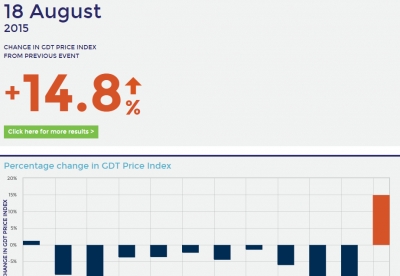
The 14.8% lift in the Global Dairy Trade overnight shows the circuit breaker that dairy markets have long needed is now in hand, ASB bank says.
Whole milk prices, which are a key to the farmgate milk price, jumped 19.1% increase to an average price of US$1856/MT.
Market focus has shifted from dairy's global glut to a potential fall in NZ production this season, says ASB rural economist Nathan Penny.
"As a result, we expect the prices to recover much of the preceding three auction's lost ground. But from there, further lifts become more difficult.
"In that respect, the auction lift reinforces our relatively optimistic $4.50/kg milk price forecast for this season. But it doesn't alter the medium-term picture materially. On that front, we now expect a more gradual recovery and have lowered our 2016/17 forecast to $6.50/kg accordingly, and this forecast's risks still point down."
Penny says for dairy prices to return to more normal or sustainable levels within 12 months, we see three necessary conditions.
• An improvement in dairy market sentiment;
• A drop (or material slowing) in NZ dairy supply; and
• A drop (or material slowing) in global dairy supply.
"The first condition we got overnight. Overall dairy prices bounced 14.8%; the first lift following 10 consecutive auction price falls. Moreover, the lift was at the higher end of expectations, with key WMP (up 19.1%) particularly strong. All up, this lift is consistent with a material improvement in market sentiment.
"The second condition, a drop in NZ supply, we have partially. We think NZ production is going to fall this season; our forecast is for a 1% drop compared to last while Fonterra expects a 2% fall in its own collections. Moreover, Fonterra's reduction in forecast auction volumes over the next 12 months (see chart) reinforces this expectation at least on the surface."
Federated Farmers has also welcomed the outcome of this morning's GlobalDairyTrade auction, but says those in the dairy industry need to remain vigilant.
Dairy Industry chair Andrew Hoggard says "The outcome of this morning's auction suggests there might be light at the end of the tunnel, but what the industry needs is for this to continue and hold."
"In the meantime, Federated Farmers will continue to work with farmers, sharemilkers and other key industry players to encourage them to re-examine their budgets and business plans, and to obtain the support of banks, farm advisors and other experts in making key decisions.
"Whether it's seeking flexibility from your bank and suppliers or doing the sums on things such as culling, drying off early or once-a-day milking, there are a number of options that dairy farmers and sharemilkers can consider to ease the pressure they will continue to face."
OPINION: Succession and long-term planning are perennial topics because it is perpetually sidelined on busy farms.
Farms across the upper North Island are trialling different pasture mixes as part of a research programme that aims to build greater resilience into farming systems.
Election years are always a concerning time for farmers, according to DairyNZ chair Tracy Brown.
Matt Collier, Probiotic Revolution, says calves will drink a lot of milk once-a-day with their probiotic Calf Xtreme.

LIC shareholders have elected a new North Island representative to the co-operative's Board, along with five representatives to its Shareholder Reference Group (SRG), following the company's Annual Meeting held in Invercargill.
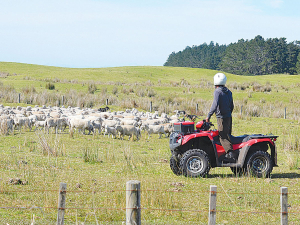
Farmers across parts of Southland and South Otago are continuing to deal with difficult conditions after a prolonged run of wet weather, with pressure building around feed supply, stock management, pasture damage, farm infrastructure and everyday workloads.
Federated Farmers says it welcomes Labour's commitment to reviewing the Sharemilking Agreements Act, calling on other major parties to do the same.
For Canterbury dairy farmers Sian Meijer and Rick Wobben, wearable technology has become one of their most valuable on-farm tools - helping manage 1850 cows across an expansive, high-performing dairy operation while improving efficiency, mating outcomes and day-to-day decision making.
Fonterra has unveiled its annual results for the 2026 financial year, posting $27 billion in revenue and close to $20 billion returned to New Zealand farmer owners and unit holders.
The first major update to the Dairy Cattle Code of Welfare in more than a decade has been released, marking what DairyNZ describes as an important step in ensuring animal welfare standards continue to evolve alongside scientific evidence and on-farm realities.