
Boosting Crop Production by Spreading Effluent
Tararua district farmer Jamie Harris milks around 400 cows using a split calving system on his farm, Crossdale Dairies.
 increase font size

A Morrinsville farmer has been fined more than $33,000 for illegally discharging dairy effluent into the environment. The volume of effluent was such that cows' udders were dragging in it.
The case, brought by the Waikato Regional Council, concerned an event in December 2011 on a farm near Morrinsville, managed by David Van Bysterveldt and owned by The David Van Bysterveldt Family Trust.
Council staff inspected the Morrinsville property following a complaint from a member of the public that effluent was being mismanaged on the farm.
The attending council staff observed that the feed-pad was thick with effluent and came halfway up one of the male staff member's size 13 gumboots (see attached photo).
The effluent storage pond at the end of the feed-pad was so full that inspectors could not determine where the feed-pad ended and the pond started. The only indicator of where the feed-pad ended was a single electric wire which was in place to prevent cattle from entering the pond.
Effluent was running from the feed-pad down on to the race and into at least three adjacent paddocks.
One of the employees on the farm stated that he made a decision to scrape the feed-pad as the effluent was so deep that some cows' teats and udders were touching the effluent.
The council investigation established that the farm had developed an abnormally high stocking rate of 5.37 cows to the hectare over a period of time leading up to this incident. (The regional average is 2.88 cows per hectare)
Van Bysterveldt pleaded guilty to a charge under the Resource Management Act arising from the incident. He was convicted and fined $33,075.
The case was heard in the Hamilton District Court before Judge Melanie Harland who commented that there were inadequate contingency measures built into the effluent storage system and that "improvements to the effluent storage system should have preceded, or run more closely in tandem with the increase in stock numbers".
Responding to the defendant's claim that adverse weather had been a factor, Judge Harland also said that there have been "enough cases now to warn dairy farmers that sufficient storage capacity to cope with unseasonable weather is a necessity".
Tararua district farmer Jamie Harris milks around 400 cows using a split calving system on his farm, Crossdale Dairies.
Water management is an integral component of sustainable farming practices, according to Watermetrics.
Two farmers and two farming companies were recently convicted and fined a total of $108,000 for environmental offending.
A Taupiri farming company has been convicted and fined $52,500 in the Hamilton District Court for the unlawful discharge of dairy effluent into the environment.
Founded in Germany as recently as 1977, today, the Fliegl Group employs more than 1100 workers, offering an expansive range of transport solutions, from their base in Bavaria.



Federated Farmers says it welcomes Labour's commitment to reviewing the Sharemilking Agreements Act, calling on other major parties to do the same.
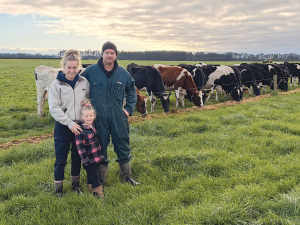
For Canterbury dairy farmers Sian Meijer and Rick Wobben, wearable technology has become one of their most valuable on-farm tools - helping manage 1850 cows across an expansive, high-performing dairy operation while improving efficiency, mating outcomes and day-to-day decision making.
Fonterra has unveiled its annual results for the 2026 financial year, posting $27 billion in revenue and close to $20 billion returned to New Zealand farmer owners and unit holders.
The first major update to the Dairy Cattle Code of Welfare in more than a decade has been released, marking what DairyNZ describes as an important step in ensuring animal welfare standards continue to evolve alongside scientific evidence and on-farm realities.
Ravensdown shareholders have elected Jane Montgomery and Kate Acland to the Ravensdown Board for three-year terms, following a closely contested director election.
Federated Farmers says new legislation replacing the Resource Management Act will cut red tape, unlock investment and help grow New Zealand's export-led economy, after the Planning Bill and Natural Environment Bill passed their third reading in Parliament yesterday.