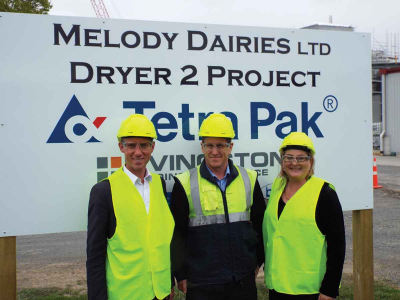
Dairy News spoke to Labour MPs Jamie Strange and Angie Warren-Clark, at the Park, where they applauded the expansion of its milk drying capacity.
After running its first spray dryer for about eight years, owners Melody Dairies has started work on dryer number 2, expecting to finish it by year end and start full production by Apr/May 2020. Full capacity will be about 1.2 tonnes/hour – 2.4 times greater than the existing unit.
The $50 million Melody Dairies plant is being developed by Pamu (formerly Landcorp), Nu-Mega Ingredients, Dairy Nutraceuticals and Food Waikato, each holding 35%, 35%, 20% and 10% respectively.
Business development manager Craig Hoare said the new dryer will process milk from Spring Sheep New Zealand and eventually from other suppliers. It will help the company to develop early-life nutrition products for export.
Its output is expected to rise to $130 million of sheep milk exports and its employee numbers from the current 17 to 35.
The market for sheep milk products is estimated to be $11.6 billion at the farmgate and $47b at retail.
Asia is a key market and sheep milk products are also popular in France, Spain, Greece and the Netherlands. Consumers like their digestibility, nutrition and taste, and they suit people with (cow milk) lactose intolerance and dairy protein allergies.
Much of the growth in sheep milk production in NZ over the last few years has been furthered by high-performance genetics from Europe.
While NZ sheep produce 100-150L of milk each season – making the model financially challenging – first-generation crosses are said to be on target to produce 300L as hoggets and 400L when fully grown, with no increase in environmental impact.
Said Jamie Strange: “This dryer is a significant investment in the Waikato region, providing economic growth for our economy”.
“I am excited to see the development of the sheep milk industry in particular. There is huge potential to increase our exports of this.”