
One Vineyard, Three Chardonnays, One Charity Auction
When Kate Lattey and Koldo Santamaria planted their dream vineyard in 2020, they knew they wanted to work with winemakers who shared their passion for wine “and expressing what the land can say”.
 increase font size
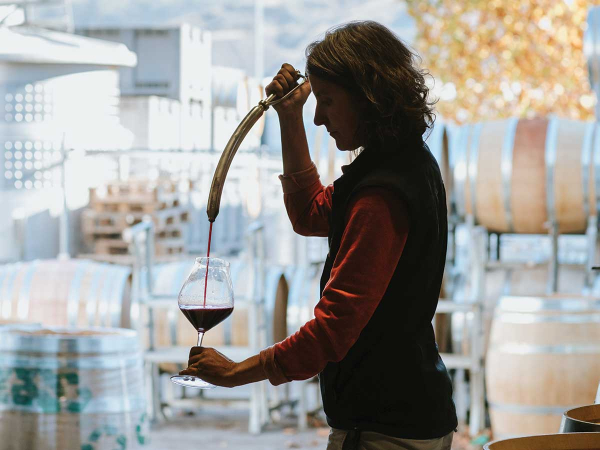 Jen Parr at Valli. Photo Credit Anna Allen
Relationships, provenance and premium positioning are helping New Zealand wineries with new customers in challenging global markets. Kat Pickford talks to wineries working hard to grow their global footprint.
Recent headlines about New Zealand wine have been dominated by oversupply, reduced caps and vineyard removals. While few are downplaying the challenges, wineries say they are also encouraging signs emerging offshore, where brands continue to attract new customers and gain ground in key markets.
For winemakers, sales teams and business owners returning from overseas, the issue is not a lack of demand for New Zealand wine. Rather, several large harvests in quick succession have left supply ahead of demand.
On a recent sales trip to Italy, part of a whirlwind tour of nine countries in eight weeks, Lawson's Dry Hills Marketing Manager Belinda Jackson says she was continually blown away by people's response upon tasting New Zealand wine for the first time. "Many of those who attended had never experienced Marlborough Sauvignon Blanc before - it was amazing watching people's reaction," Belinda says. "This was a good follow up to visiting last year, when we got an 80% strike rate of new restaurant listings."
 |
|---|
|
Belinda Jackson, Lawson's Dry Hills |
The trip took her through Europe, the United Kingdom and Asia, meeting importers, retailers and distributors along the way. Despite the economic pressures facing many regions, Belinda says buyers remain enthusiastic about New Zealand wine. "What stands out to me is that everywhere is facing challenges of one sort or another. However, those who take a positive attitude, stay close to their customers and have a compelling brand offering will do well."
Spy Valley Wines Managing Director Amanda Johnson has found much the same thing during recent trips to Asia, the Nordics and North America. "We are constantly hustling, not trying to put all our eggs in one basket, and really trying to stay engaged with international markets - both looking for new prospects and backing up our relationships with the buyers and distributors we know and love."
Those opportunities don't happen by accident, Amanda says. "We made a conscious decision when doing the budgets a year ago to move funds to allow for extra time in market. One of the most valuable things about it is hearing directly what's happening at shelf level and on wine lists, and spending face time with importers and customers rather than relying on secondhand reporting." Those efforts appear to be paying off. Despite what Amanda describes as a difficult year globally for wine, Spy Valley has recorded increased sales.
Being close to customers has become a priority for many wineries, including Te Mata Estate in Hawke's Bay. During the Covid travel restrictions, the winery appointed representatives to work alongside buyers and distributors in Europe, the United States and Australia. The investment has paid off, says Chief Executive Nick Buck. Sales in the US have grown 30% year-on-year over the past two-and-a-half years, while Europe has continued to deliver growth despite the challenges created by the war in Ukraine, the energy crisis, and local wine oversupply. "The response to the quality of our wine from consumers overall has resulted in strong growth over what has been a very challenging time socially, politically and economically... we're very conscious that nothing comes easy at the moment."
While Te Mata Estate operates at the luxury end of the market and is focused primarily on red wines, Nick says the fundamentals of exporting remain the same. “I’ve always believed the great strengths of Hawke’s Bay remain in its ability to produce a wide array of wines to an extraordinary standard… We have great diversity – the challenge is communicating that to buyers. Site-specific and subregional wines is a complex message to take to our customers; that’s why having good market representation is crucial.”
Communicating your story effectively has become increasingly important in a crowded international arena, says Hunter’s Senior Winemaker James Macdonald. Against the backdrop of several challenging years for the wine industry, the family-owned winery recently embarked on a significant rebrand, more than four decades after founder Ernie Hunter planted the company’s first vines in Marlborough.
After years of investing in vineyards, people and equipment, James says the focus shifted to better communicating what makes Hunter’s unique and reconnecting with customers who may have known the brand, but not its story. “It was an expensive long-term exercise, but it’s paying off,” he says. “It’s been an opportunity to go back to people with our renewed focus on quality winemaking. Tapping into what made Marlborough and Hunter’s successful in the first place – making great, compelling wine.”
 |
|---|
|
James Macdonald at Hunter's Wines |
Extensive travel to key export markets this year has reinforced that message. “After being on the ground, the mood is pretty good,” James says. “We’re getting really great feedback. We’ve sold out of our 2025 and started selling 2026 Sauvignon Blanc, which is getting some really positive responses. It’s much easier to sell good wine than average wine in a competitive environment.” The bigger challenge is making sure people know about it, he says. “Some of New Zealand’s biggest wine brands don’t even have a social media presence.”
For all New Zealand wine’s international success, there are still many wine drinkers around the world who have never tasted it – a gap that wineries are working hard to close. Valli Wines Winemaker Jen Parr has encountered a similar response during recent visits to Hong Kong, Japan, California and Australia, where she says New Zealand wines continue to resonate strongly with those discovering them for the first time. “People love the wines from Central Otago (and New Zealand generally) but the reality is that we aren’t particularly well known, outside of Australia perhaps.”
Despite strong recognition among those already engaged with wine, Jen says New Zealand still faces significant competition in major export destinations, particularly in premium Pinot Noir, where producers are competing against established regions such as Oregon, California and Europe. “Sitting here in Melbourne, the competition from Australian Pinot Noir and Chardonnay is really evident. People have started to prioritise drinking local wines and Australian Pinot is getting better and better. There is a lot of competition in the Pinot Noir space, but strong brands and premium wines are still sought after.”
New Zealand’s long-term growth lies in continuing to build awareness and deepen understanding of what sets the country apart in international markets, she says. “I think the sustainable, regenerative message, along with the rugged beauty and natural wonders of our country, is important to help differentiate us from more industrialised countries that produce wine.”
Premium positioning remains central to how New Zealand wine differentiates itself in global markets, but changing preferences and drinking occasions are also helping some producers reach new customers. Matua Winery Manager Gavin Williams says New Zealand is well placed to capture this demand in both established and emerging regions. “Globally, the wine category continues to evolve, with consumer preferences shifting toward lighter varietals and styles.”
Over the past two years, lighter wine styles have increased their share of the wine category in key global markets, and Matua is benefiting from the trend. The winery’s low-alcohol Sauvignon Blanc has recorded 40 consecutive weeks of growth in the US, while new formats such as cans and bagnums (magnum-sized wine in a bag) are helping attract new consumers, he says. While the numbers may appear incremental, in a sector grappling with falling consumption and changing drinking habits, holding ground – let alone growing – is a positive sign.
That sentiment is also reflected at a corporate level, with some of the world’s largest wine companies continuing to view leading New Zealand wine brands as an important part of their future plans. At the centre of that confidence remains Marlborough Sauvignon Blanc, the varietal that first put New Zealand wine on the world stage and remains the backbone of the country’s wine exports.
 |
|---|
|
Amanda Johnson in the United States |
Constellation Brands recently reaffirmed its commitment to Marlborough-based Kim Crawford and Drylands as part of a global portfolio focused on premium brands. Meanwhile, Treasury Wine Estates has identified Matua as one of just three global “Power Brands”, alongside Penfolds and DAOU. NZX-listed Delegat Group recently reported strong global sales, while Australian drinks giant Endeavour Group retained Marlborough’s Isabel Estate as one of only three wineries in its portfolio following a strategic review.
Behind that optimism is genuine demand for New Zealand wine. But wineries say the industry’s future will depend just as much on protecting the reputation that created those opportunities in the first place. While demand for lighter, fresher wine styles continues to support New Zealand wine in key export destinations, concerns remain about how some of that wine is being presented and priced.
Buyers overseas are still reporting widespread availability of heavily discounted Marlborough Sauvignon Blanc, often from little-known brands, several wineries say. “The response to Marlborough has become somewhat muted given the volumes being produced and the low prices it is being sold for,” says Belinda. “At times it was hard to see New Zealand commanding the premium it always used to and I was frequently being told of the cheap wine that companies were being offered. The warning was clear – continue to drive brand Marlborough as mass-produced, diluted and cheap, and our bubble will burst.”
Amanda agrees, saying the contrast between premium and commodity wine has become increasingly stark. “Demand for authentic, premium New Zealand wine brands remains strong, even in a very challenging global environment. At the same time, there’s enormous pressure in grocery from heavily discounted Sauvignon Blanc, particularly in the UK and US.”
Nick says that in this environment, how wine is positioned in market becomes just as important as volume. He notes that while bulk wine can offer short-term scale through supermarket channels, it is not always a stable foundation for long-term growth. “Te Mata has focused on building relationships with engaged distributors and on-premise channels, where buyers are typically more wine-informed and focused on provenance, quality and regional identity,” he says. “This approach is supported by strong recognition of New Zealand’s position as a cool-climate wine producer, backed by awards, critical reviews and brand history.”
Hunter’s Wines has taken a similar approach, with a continued focus on more engaged, wine-led channels rather than competing on price in highly promotional retail environments. “Instead of chasing price, we’re doubling down on what makes our wine distinctive,” James says. “We’ve got to believe in what we’re doing. Our competitive advantage is our uniqueness and authenticity. That’s what makes us stand out against the more industrial winemaking methods that are so prevalent globally.”
The importance of storytelling, education and engagement becomes more apparent the more time Jen spends in trade. Building recognition is not an overnight process and requires sustained effort with buyers, especially as competition intensifies, she says. “Selling the premium story is important.”
After several decades building export markets, wineries are now taking those learnings into a new wave of emerging opportunities. Amanda says early activity in South America has been encouraging, with tasting events in Brazil this year generating early interest and follow-up leads.
“We had a great time in South America,” she says. “We had 12 leads, six of which converted into actual genuine follow up. We’ll keep building on those relationships.”
Looking further ahead, attention is also turning to emerging prospects such as India following the Free Trade Agreement – a vast and largely untapped destination for New Zealand wine. “India is a huge territory in itself, but it’s not one we’ve historically engaged with in any meaningful way,” Amanda says. “It will be interesting to see where it leads over time.”
The conversation around new export destinations reflects a broader point Nick makes about the future direction of New Zealand wine. One of the challenges for the industry is the tendency for people to do what everyone else is doing, he says. “It’s a big wide world out there – we don’t necessarily all need to be in the same place.”
There is real potential for producers to take a more direct, long-term approach to development and investment, particularly given the relatively small scale of the New Zealand industry. “There’s plenty of ground still to explore on the fringes,” he says. “People buy wine from people. It’s all about relationships.”
While driving through New Zealand’s wine regions, with vineyards stretching across the landscape, it can be easy to assume there are too many – particularly in the context of current oversupply. But as James points out, New Zealand is small by global standards, with Marlborough alone comparable in scale to Champagne. The current pressure facing the industry is largely a production issue rather than a demand one, with supply running ahead of consumption in some industry segments.
 |
|---|
|
Nick Buck at Te Mata |
Nick points to the US as a key example – the world’s largest wine market – where conditions have shifted after an extended period of growth. While the overall category has contracted, he says New Zealand wine and Italian Prosecco are the only two styles to hold steady or continue growing. “It might not seem like a measure of success to not go backwards, but growing your market share in the biggest wine drinking region in the world is absolutely a win during what has been a very challenging period.”
Nick says nothing fundamental has changed about New Zealand wine, which continues to offer diversity, quality and a clear point of difference internationally. “We’ve got something completely unique. We just need to make sure that value is properly understood and recognised offshore.”
South Korea is emerging as one of New Zealand wine’s most exciting growth opportunities, says Charlotte Read, New Zealand Winegrowers General Manager Brand. On a recent visit she was “blown away” by how fast the New Zealand wine category has expanded in the past decade. “What had been a handful of New Zealand wine brands on wine store shelves has transformed into a vibrant New Zealand category in retail stores.”
Korean wine drinkers increasingly favour lighter, fresher and more fruit-driven styles, and Sauvignon Blanc is now the most popular white wine variety there. “This aligns perfectly with New Zealand’s strengths, with Marlborough Sauvignon Blanc continuing to act as a powerful entry point for consumers,” Charlotte says.
NZW has supported New Zealand Trade and Enterprise in research to learn more about Korean wine consumers. While awareness of New Zealand wine remains relatively low compared with that of more established wine-producing countries, the research shows that Korean consumers respond exceptionally well once they discover New Zealand wines, Charlotte says. “We simply need to increase our visibility.”
NZTE South Korea Head of Business Development You Jin Lee will speak at the NZW 2026 Wine Business Forum on 27 August, sharing first-hand perspectives on consumer behaviour, market trends and the opportunities ahead.
When Kate Lattey and Koldo Santamaria planted their dream vineyard in 2020, they knew they wanted to work with winemakers who shared their passion for wine “and expressing what the land can say”.

For the past 35 years, Philip Gregan has helped select New Zealand Winegrowers Fellows, working with the board to choose a cohort of extraordinary industry champions.
New Zealand Winegrowers' new Chief Executive Officer Anishka Jelicich says a career working abroad in the global wine and drinks sector has given her opportunity to see New Zealand wine through the eyes of the world.
When the youngest generation of the Spy Valley Wines' founding family were little, a tractor ride was a popular before-school thrill, and vineyard-fresh grapes a delicious snack.


