New dimension in fert application
With new nitrogen fertiliser restrictions due to kick in during July 2021, with a target to apply less than 190 units N/ha, many farmers will be having a re-think on fertiliser application.
 increase font size
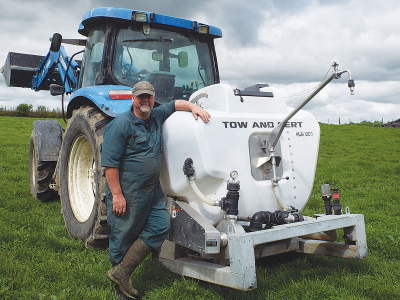 Matamata farmer Matthew Zonderop says he’s never looked back since he started using a Tow and Fert unit about three years ago.
Matamata farmer Matthew Zonderop says he’s never looked back since he started using a Tow and Fert unit about three years ago.
Zonderop farms 140ha in a 50:50 partnership at Te Poi, near Matamata, running a herd of 420 cross-bred dairy cows.
Having previously used conventional fertiliser, Zonderop saw a friend using the Tow and Fert system with success and decided to take the plunge.
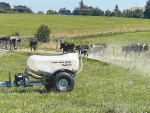
In essence the unit is a heavy-duty spraying rig, with an integral mixing and agitation component.
Zonderop’s Multi 1200 linkage mounted machine comprises a 1200L moulded tank carried in a heavy-duty galvanised frame, pipework with extensive use of stainless steel and attachment via snap-lok fittings.
The design offers the ability to dissolve and mix urea, lime, gibberellic acid, weed sprays, trace elements, humates and seeds – using dairy effluent or water as the medium for application.
Manufacturer Metalform says foliar application of nutrients leads to quicker uptake, reduced losses to the atmosphere and leaching.
An added benefit of this spraying rig is that it is able to combine several products in a single mix to help reduce labour and operating costs.
Zonderop runs a grass-based system that typically sees paddocks being grown to 2900 to 3100 kgDM/ha prior and 1500kgDM post-grazing.
The sprayer moves onto the paddocks about five days after grazing to apply sulphate of ammonia, Pro-Gib and,
if required, Baton herbicide.
“Application is very uniform and up to 10m width depending on wind conditions,” he says.
“Interestingly, paddocks show a noticeable response within 4 or 5 days – probably 2 or 3 times quicker than conventional methods.”
The process sees 500kg of fertiliser dissolved and carried in 900L of water, a process that takes about 15 minutes, with agitation/circulation continuing as the unit moves to a job. Zonderop believes the rapid uptake of nutrients by plants allows him to reduce application rates, saving about 25% over conventional application methods.
Operation is said to be easy with a in-built weigh system, a distinct lack of electronics and the only real choice being nozzle selection to alter application rates.
Beyond the fertiliser application, the machine is also used to apply magnesium sulphate in spring, as a blanket coverage said to last for up to 90 days before grazing. This saves the daily chore of application by ATV and spreader.
The same principle is also used for the application of zinc sulphate for facial eczema prevention, although a half dose is still used in the water supply as an insurance policy.
The rig can also apply chicory seed in suspension, with the occasional application of grass seeds in rougher areas.
Interestingly, last season saw an extended dry period when crops of turnips or chicory were being established, so the Multi 1200 was brought into action for irrigation, applying effluent diluted 50:50 with water. Zonderop concedes this was a time-consuming job but it broke the drought.
With new nitrogen fertiliser restrictions due to kick in during July 2021, with a target to apply less than 190 units N/ha, many farmers will be having a re-think on fertiliser application.

The saying goes ‘when things get tough, the tough get going’ and this is happening here in New Zealand and further afield.
Reporoa farmer Alistair Neville is using the Tow and Fert range for more environmentally-friendly farming practices.
Reporoa farmer Alistair Neville is using the Tow and Fert range for more environmentally-friendly farming practices.
Tow and Fert sprayer systems made by Metalform have been around for several years, growing in popularity with users who cite reduced costs and other benefits.


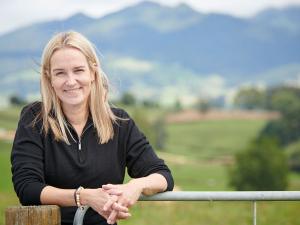
Minister of Conservation Hon Tama Potaka has appointed Susan O'Regan as Chair of the Queen Elizabeth II National Trust (QEII) for a three-year term.
Red meat farmers are welcoming Labour’s plan to review the Emissions Trading Scheme and not to campaign on pricing agricultural emissions.
Where any worker in the kiwifruit industry is mistreated, we expect the authorities to take action.
Mid Canterbury Federated Farmers arable chair, Bevan Lill, said Beef + Lamb NZ data indicated that for the last six years, the average arable return on investment was about 0.8% while inflation ran about 4% - so the average arable farm was going backwards at about 3% a year.
Seed and grain companies share the concerns of arable farmers about the viability of their sector, says Seed and Grain New Zealand chief executive Dr Sarah Clark.
The New Zealand Institute of Forestry (NZIF) says unnecessary changes to New Zealand’s Emissions Trading Scheme (NZ ETS) will seriously erode investor confidence and result in significant reductions in forest planting rates.