Kuhn Group Sales Dip 9% in 2025 but Orders Signal Recovery
Kuhn Group recorded net sales of NZ$2.27 billion in 2025, finishing around 9% lower than in 2024.
 increase font size
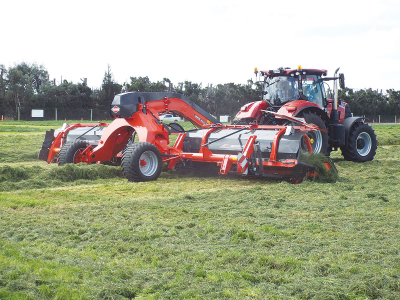 The Merge Maxx 950 in action.
Twin or four rotor tine-based swathers tend to dominate the market for machines that will satisfy the voracious appetites of self-propelled foragers and large balers.
But the French grassland and cultivation specialist Kuhn has recently introduced a new concept that moves away from this format.
The Merge Maxx 950 uses individual tine-based pick-ups, which in turn feed onto belt conveyors to form the required swath, in a choice of eight delivery options.
A substantial central frame and heavy duty rear wheel and tyre equipment carry the two raking and conveyor elements.
The pick-ups have five tine bars controlled by a cam system for clean raking, and a wind guard and roller layout for accurate clearing. Pick up height is controlled by steplessly adjustable skids under each unit, working with a spring suspension system.
The crop is lifted by the pick-up, from where the material is fed onto the belt conveyors. These gently handle the crop and place it into a windrow. The format is said to be ‘gentler’ than tine-based layouts that move crop across the ground. It reduces the risk of seed head loss, leaf shatter and soil contamination.
Dependent on the crop, terrain and, of course, the following machine, the Merge Maxx can be set for centre or side delivery. The former offers an 8.2 to 9.5m clearing width and delivers a swath up to 2.5m wide. Side delivery can clear 8.8m and finished swathes are 1-1.5m.
For clearing larger areas, either for high power harvesters or when raking in light crop conditions, swathes can be lifted two, three or four times to maximise volume. Importantly, this reduces the following passes of subsequent machines and haulage crews, so saving fuel, tyres, wear and tear and ‘wheelings’ in the paddock.
A self-contained hydraulic system eliminates the possibility of cross contamination from different tractors. The speeds of the pick-up and conveyor assemblies can be adjusted steplessly to suit crop conditions or operating speeds.
In operation, the Merge Maxx is said to travel 2-3km/h faster than typical tine-based machines. This means it can stay ahead of the largest harvesters.
Operation is said to be simple, using a push-button control box to change functions such as tine or belt speeds, belt directions and headland lift and lower sequences.
Kuhn Group recorded net sales of NZ$2.27 billion in 2025, finishing around 9% lower than in 2024.
ZED, the dedicated wholesale division of CB Norwood Distributors, and the importer and distributor for Kuhn in New Zealand, has announced investment in local expertise and stock availability for customers in 2026.
Kuhn has announced an expansion of its range of disc mowers, distributed by Norwood in New Zealand, with the addition of two new vertically folding rear mounted models, the GMD 3515 and GMD 4015.
With most forage harvester manufacturers offering machines touching 1000hp, the logistics puzzle has always been ‘dropping” grass and pulling into a swath big enough to feed the “beast”.
French company KUHN has won a EIMA Technical Innovation Award for its Baler Automation Technology.


Converting a longstanding cropping farm to dairy was the only way to ensure the land stayed in the family long term, says new dairy farmer Rod May.

As the election heats up, Organics Aotearoa New Zealand (OANZ) has launched its election scorecard designed to help voters wanting to support policies that grow organic and New Zealand's organic sector.
A 'tsunami' of milk from key exporting countries is winding down and this may be good news for New Zealand dairy farmers.
Will the good times last? That's one of the key issues to come out of the latest Federated Farmers confidence survey.
Outgoing Fonterra Co-operative Council chair John Stevenson says that it has been a privilege to represent the co-op's farmer shareholders.
Have a plan in place for your cows and staff.