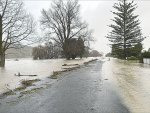
Wairoa flood review findings released
A review into the Wairoa flooding event on 26 June 2024 has found the flood was caused by a combination of factors leading to the river backing up and overflowing.
 increase font size
 Floods and slips on Ian & Barbara Stuart's Cable Bay property
THE WORST rain storm for over 20 years is battering rural and urban property alike in the Tasman and Golden Bay regions.
Farmers face silted paddocks, washed away bales, closed roads and broken fences and water lines.
“Probably the worst affected farming community is the west of Takaka because there’s a slip that’s closed the road,” Federated Farmers Golden Bay provincial president Graham Ball told Rural News.
“There are probably 45 or 50 dairy farms that won’t have their milk picked up. That’s a huge concern because they’re saying it might be four or five days before the road’s fixed.”
With capacity to store two, or at most three days’ supply, some could be forced to dump milk to pasture through the effluent system.
On his own farm water pipes have been washed away, requiring temporary repairs just to be able to washdown the shed. There’s a sense of déjà vu to the job, having had to make similar repairs last Christmas.
“On the 28th of December last year we had the big Aorere flood which did a similar thing. That added two weeks’ extra work.”
That said, with the rain easing this afternoon, this storm could have been much worse, he adds.
“If the rivers had come a bit higher there would have been a lot more damage. The Aorere valley has a bit of silting but nothing like last December at this stage.”
Similarly the Takaka river had coped with the deluge, despite some reports of 700mm of rain over the past 48 hours.
Feds’ Nelson provincial president says the damage there is mostly in the east, along the fringe of the Richmond ranges and north of Nelson.
“There are lots of surface slips... but it’s difficult to see with the cloud low and the rain still falling.”
On most farms “it’s not too bad” he says, though some hay and silage paddocks have been inundated.
“I saw 50 or 60 round bales that had floated across a paddock and ended up in a culvert.”
At Cable Bay, northeast of Nelson, farmers and holiday parker owners Ian and Barbara Stuart are cut off by slips.
“We have a couple of stranded campers in the camp who will not be able to leave today and the farm is a wreck – slips everywhere,” they told Rural News.
They managed to stop the creek flooding into most of the camp and were hopeful they’d be able to resume holiday business when the road’s opened.
“Our house is Ok but I fear many of the residents along the road will have substantial damage to their properties. It’s been a long eerie night listening to rocks in the creek and wondering what damage daylight would bring.
“The rain gauge overflowed overnight so we have no idea what has fallen except to guess over 300mls!”
Nelson Mayor Aldo Miccio says rainfall over the last two days has broken a number of records triggering a state of emergency, “something the region has not seen for over 20 years.”
“While the rivers have been coping relatively well the rain has caused severe surface flooding and has saturated land to the point of movement. This is not a short term event - its effects are going to be felt for some time.”
A review into the Wairoa flooding event on 26 June 2024 has found the flood was caused by a combination of factors leading to the river backing up and overflowing.
Despite recent rain, drought is forcing Hurunui farmers into some difficult decisions, says Federated Farmers North Canterbury provincial meat and wool chair, Sara Black.
Recent high rainfall events in South Canterbury have highlighted the role the Opuha Dam plays in managing floods.
The Mayoral Relief Fund to help communities in the Nelson/Tasman and Marlborough communities will get a $200,000 boost from the Government, Minister for Emergency Management Kieran McAnulty has announced.
As severe weather ravages the West Coast and Nelson-Tasman regions, calls are being made for solutions to flood risk.



Āta Regenerative is bringing international expertise to New Zealand to help farmers respond to growing soil and water challenges, as environmental monitoring identifies declining ecosystem function and reduced water-holding capacity across farms.
Yili's New Zealand businesses have reported record profits following a major organisational and strategic transformation.
Owners and lessees of certain Hino Trucks New Zealand diesel vehicles have just 10 days remaining to register or opt out of a proposed $10.9 million class action settlement.
Silver Fern Farms has successfully produced and delivered 90 tonnes of premium chilled New Zealand lamb and beef to the United Arab Emirates via airfreight.
For the first three months of 2026, new tractor deliveries saw an increase over the previous two months, resulting in year-to-date deliveries climbing to 649 units - around 5% ahead of the same period in 2025.
QU Dongyu, director-general of the Food and Agriculture Organization of the United Nations (FAO), has issued a warning saying that global fertiliser scarcity caused by disruptions in the Strait of Hormuz will lead to lower yields and tightening food supplies into 2027.