PGG Wrightson Revenue Tops $1.1b as Profit Jumps 46%
After delivering a strong financial year, rural trader PGG Wrightson says the coming months will depend on customer confidence and weather.
 increase font size
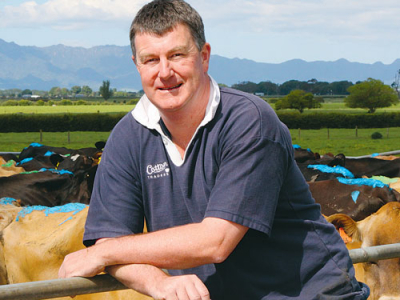 Outgoing chief executive Mark Dewdney.
The 2018 financial year has begun with confidence high among dairy, beef and horticultural clients due to good commodity prices, says PGG Wrightson in its first quarter guidance update to shareholders.
But price is only half the story, it says.
Currently the forecast dairy payout stands at a healthy $6.75/kgMS, and gold kiwifruit orchards continue to sell for at least $1 million per canopy hectare.
But recent estimates from Beef + Lamb New Zealand warn of a significant contraction in forecast production throughout NZ, the update says.
BLNZ estimates the total number of lambs tailed in the spring of 2017 at 23 million head, down 1.3% (0.3 million head) on the previous spring, reflecting fewer breeding ewes.
“This drop contrasts with previous indications that the lamb flock might be up about 1.1%,” the update says.
“In addition, beef production is expected to be static year-on-year.
“For dairy, early season milk production has been hampered by weather conditions being generally too wet over recent months.
“August NZ milk production was down 1.5% on last year (which was down 3% on the year before that).
“Milk production is ramping up for spring, but the BNZ, for example, suspects it will not be as strong as it usually is given recent weather conditions. This is tempering their forecast for the season as a whole.
“They still expect milk production this season to be higher than last season but not quite as much as they had previously thought -- maybe up in the 1 - 2% range rather than a 3 - 4% range.”
Wet conditions through winter and early spring is delaying the key spring sales season, the update says.
“While the delay is not yet significant enough to suggest lost sales, the risk of a poorer spring for PGW is somewhat heightened compared to a few months ago.
“Currently PGW is about $2m behind the same time last year but there is confidence of making up this ground as the spring season accelerates.”
The company is forecasting a full year operating EBITDA to June 30, 2018 similar to 2017 earnings of $64.5m.
Its 2017 net profit after tax included non-operating items of $9.5m, of which $8.74m related to capital gains on the sale of properties. As this is now largely complete PGW is expecting net profit after tax to be about 30% lower than 2017.
“It is important to note that it remains early in the financial year to be forecasting, with most of the year’s trading still ahead.”
PGW deputy chairman Trevor says Ian Glasson, appointed chief executive, was scheduled to start last Wednesday (November 1).
New boss takes over
Gold Coin/Zuellig Agriculture head Ian Glasson has taken over as PGG Wrightson’s chief executive, succeeding Mark Dewdney, who signalled his departure in June.
Glasson has long worked in agriculture including Gold Coin, where he ran a billion-dollar animal feed and farming ventures, and related Zuellig business CB Norwood Distributors in Australia and New Zealand.
“Ian brings impressive qualifications for leading an agricultural business such as PGW and we are pleased to have him join,” chair Alan Lai says.
“He will remain an external director of SunRice, the large branded rice food company.”
Dewdney, a former chief at Livestock Improvement Corp, replaced George Gould in charge of Wrightson, coming in just after the rural services firm wrote off $321m from the goodwill accrued in the 2005 merger with Pyne Gould Guinness. Since then, Wrightson has posted stable earnings despite last year’s dairy price slump.
Wrightson increased annual profit 5.7% to $46.3m in the June 2017 year, even as sales were weighed down by wet autumn conditions hampering the NZ harvest and dragging on the firm’s seed and grain business.
After delivering a strong financial year, rural trader PGG Wrightson says the coming months will depend on customer confidence and weather.
Tatua chair Stephen Allen says he leaves the co-op with a deep sense of gratitude for the people who have contributed to its success.
Tatua Co-operative Dairy Company has confirmed that chair and director Stephen Allen will retire at the co-operative's annual general meeting (AGM) on 3 December 2026, ending 30 years of service, including more than 20 years as Chair.
Strong competition and tightening supply have seen wool reach its highest prices paid at auction since 2011.
A firm belief in the agricultural sector has kept the PGG Wrightson business going for 175 years, says chief executive Stephen Guerin.


Hawke's Bay fruit growers are being reminded of the need to prepare for whatever the El Niño weather system may bring in the coming months.
Three and a half years on from when Cyclone Gabrielle hit Hawke's Bay, some orchardists in the region are still receiving counselling to help them deal with the trauma they suffered.
South of the central Hawke’s Bay town of Waipukurau is Taniwha Station – a highly successful 550ha bull beef farming operation.
Beef + Lamb NZ funded research has shown that some simple changes to pasture management could help farmers make better use of rainfall and build resilience before dry conditions hit.
OPINION: There could hardly be a more appropriate theme for a conference than the one chosen by the red meat sector - Navigating Volatility.
When Northland leather worker Vernon Suckling started making horse saddles 50 years ago, quad bikes and side-by-side vehicles were unheard of.