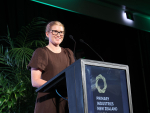
Waikato Dairy Farmer Danielle Hovmand Named Primary Sector's Top Emerging Leader
Waikato dairy farmer Danielle Hovmand has been named the primary sector's top emerging leader.
 increase font size
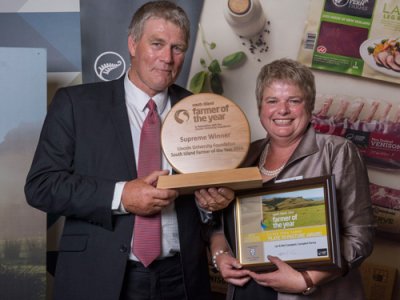 Neil and Lyn Campbell.
A husband-and-wife “super team” has secured the title of the Lincoln University Foundation’s South Island Farmer of the Year at the 2016 finals held tonight (Wednesday 16 November).
Chief Judge Nicky Hyslop says that Neil and Lyn Campbell won the judges’ praise with the “efficient, incredibly flexible and adaptive” approach to the way they have developed their dryland property. Their focus has been on systems that allow them to pursue activities that generate the most profit at the most effective point of time, with land stewardship always the foundation of their decisions.
The Campbells’ farm consists of 769ha of rolling hills and flats in Middle Valley near Fairlie in South Canterbury, producing sheep, deer breeding and finishing, and a variety of crops.
Speaking to the secret of their success, Neil Campbell says, “we can’t compete on the basis of volume and, likewise, we aren’t big enough to compete by going straight to the market. Therefore our best option is to deliver each product at the time when it is most profitable.”
Hyslop says when Neil and Lyn moved to their property their aim from the start was to be in the top 10% of producers. They not only changed how the property was run, they instigated detailed analysis systems so every aspect of the farm operations could be measured and compared against key performance indicators.
“Neil and Lynn use accurate data to validate their decisions,” Hyslop says, “there’s no reliance on hunches or assumptions. Hard data is analysed to compare and choose between the different enterprises on the farm.”
Hyslop added that the farm’s small paddock sizes also allowed for specialist crops to be grown – such as oat and grass seed, and rape seed for oil – for maximum return.
“We go from summer dry valley floor to higher altitude moist hill country,” Neil Campbell explained. “Some of the things we are doing at altitude are more common at sea level, like growing crops. The diversity of our business gives us strong balance environmentally and financially.”
In the future, the Campbell’s hope that the farm remains in the family and the judges noted the succession planning they had in place. Their aim is for a sustainable and environmentally compatible farm producing highly nutritious food.
“Our biggest and most important goal is to continue to enjoy what we do,” Neil Campbell says. “Farming is a fantastic industry; if we can be part of telling that story and encouraging the younger generation into the industry we would be most satisfied.”
The Campbells win a $20,000 travel grant for study and/or to further their business.
Four special category prizes of $500 each were also awarded tonight. They were:
· The Silver Fern Farms “plate to pasture” award for the best consumer awareness by a red meat farmer: Neil and Lynn Campbell
· The Lincoln University prize for best use of new technology and innovation: James Dicey, Ceres Wines
· The Farmlands prize for best on and off -farm resource management: James Dicey, Ceres Wines
· The Lincoln University Foundation award for human resource management, Mendip Hills Station (Simon and Miesha Lee).
The Lincoln University Foundation will host a winner’s field day at the Campbell’s Fairlie property early in 2017 (date to be confirmed).
Waikato dairy farmer Danielle Hovmand has been named the primary sector's top emerging leader.
New Zealand’s wine industry produces around 100,000 tonnes of grape marc waste annually, while the forestry sector generates over five million tonnes of wood residue.
A young man just five years out of his Lincoln University degree already has his foot in the door of farm ownership, as equity manager of a large new dairy conversion now taking shape in Mid- Canterbury.
Analysis of decades of research has revealed the good farming pracrtice plays a critical role in reducing nutrient losses to improve freshwater outcomes.
A Lincoln University research fellow is working to safeguard grapevine species from extinction, using careful science and liquid nitrogen.
New Zealand dairy farmers are set to be the first in the world to receive access to a new digital physical milk pricing tool that enables them to fix the price for their physical milk.
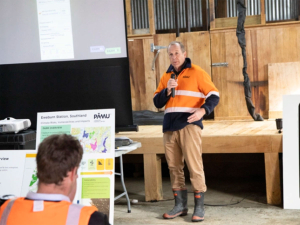
State farmer Pāmu is opening its farm gates this summer in an effort to give the rural sector the opportunity to see how large-scale, multi-system farming is delivering productivity and profitability across New Zealand.
A five-year study has found that the cost of reducing emissions without technology may be significant and unsustainable for Northland dairy farmers.
DairyNZ says Waikato farmers need certainty on Plan Change 1, but they say that certainty must be matched with practical, workable rules and a clear transition that doesn't get ahead of the new resource management system currently under review.
While the Government has moved quickly to make commercial hauliers' lot easier during the current fuel crisis, they appear to be stuck in the creep box when it comes to the agricultural industry.
Waikato farmers have been told that the Government’s new planning system legislation and the region’s Plan Change 1 (PC1) “won’t mesh together very well”.