NZ ETS Settings Hold Steady Amid Shortfall Warning
The Climate Change Commission has recommended maintaining the current New Zealand Emissions Trading System (NZ ETS) settings but warns of a potential unit shortfall as early as 2028.
 increase font size
 DairyNZ chief executive Tim Mackle
Farmers are happy to play their part in reducing greenhouse gas emissions but the Government has to come to the party.
With the Climate Change Commission (CCC) delivering its final advice last week, DairyNZ chief executive Tim Mackle says it is now up to the Government to deliver a credible emissions reduction plan for New Zealand - and the investment in tools and support required to achieve it.
The CCC is calling for a 13.6% reduction in livestock numbers by 2030. It expects this to drop by 8% anyway and recommends a further 6% reduction. The expectation is for the country's farmers to still produce the same amount of milk and meat from the fewer animals.
This expectation is described as 'ambitious' and 'a tough call' by the farming sector. Mackle says a 10% reduction for biogenic methane recommended by the commission will be "incredibly challenging" for farmers. However, he says they are committed to playing their part and reducing emissions alongside the rest of the economy.
"We are pleased the goalposts haven't shifted from the Zero Carbon Act and farmers now have certainty they need to make long-term investment decisions."
Mackle agrees with the CCC that New Zealand urgently needs a long-term plan for R&D investment from industry and government, to help us rise to the challenge.
"Investment in rural digital connectivity is also required to enable farmers to have better reporting and rapid uptake of new technologies to drive down emissions."
Meanwhile, red meat farmers support some aspects of the commission's final advice to the Government - including the 'split gas' approach domestically to treat short-lived and long-lived greenhouse gases differently, to reflect the fact that different gases have different warming inpacts on the atmosphere.
However, the sector is disappointed at the "lack of recognition" of the marginal impact methane-emitting sectors have had on the atmosphere for the past 20 years.
"The science is clear, methane emissions in New Zealan have contributed little additional warming since the early 2000s," says Beef + Lamb NZ chief executive Sam McIvor.
"Furthermore, methane emissions from sheep and beef production have decreased by about 30% since 1990. At the same time, warming from fossil fuel emissions has increased significantly."
DairyNZ wants farm system improvements for further integration of dairy and beef sectors.
Mackle says farmers are committed to doing their fair share and playing their part alongside the rest of the economy - but the work needs to be fairly spread.
"We do remain concerned agriculture may be asked to do the heavy lifting if we don't see urgent action to reduce CO2 emissions," he says. "We are all in this together and we must have a fair and balanced plan that requires our communities to contribute equally."
Mackle said NZ dairy farmers are world leaders at producing sustainable and emissions efficient dairy products.
"Independent research shows our milk has the lowest carbon footprint in the world. On top of this, we have a credible plan in He Waka Eke Noa to manage, reduce and price agricultural emissions. We will be the only country in the world charging farmers to do this - elsewhere farmers are often paid to," says Mackle.
Dairy currently makes up 34% of our total exports at $20b and employs over 50,000 people.
"We're looking to produce the same, or more, with fewer emissions and that is a big target for us to hit," says Mackle.
"We want to maintain our economic contribution to Kiwi communities and our position as the world's most emissions efficient producer of milk. That means we need pragmatic targets and new technologies."
The Climate Change Commission has recommended maintaining the current New Zealand Emissions Trading System (NZ ETS) settings but warns of a potential unit shortfall as early as 2028.
The Climate Change Commission’s 2025 emissions reduction monitoring report reveals steady progress on the reduction of New Zealand’s climate pollution.
Former Governor-General Dame Patsy Reddy will be the new chair of the Climate Change Commission.
The dairy industry is well placed to front the cost of new technologies to deal with methane emissions, but the sheep industry isn't.
There is an urgent need for the Government to put a limit on the sale of farms for forestry - particularly for carbon farming.


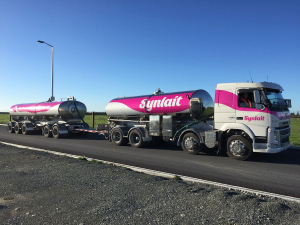
Synlait has swung to second-half profit as operations stabilise, but the dairy processor still posted a $75.4m annual loss.

LIC shareholders have elected a new North Island representative to the co-operative's Board, along with five representatives to its Shareholder Reference Group (SRG), following the company's Annual Meeting held in Invercargill.
Farmers across parts of Southland and South Otago are continuing to deal with difficult conditions after a prolonged run of wet weather, with pressure building around feed supply, stock management, pasture damage, farm infrastructure and everyday workloads.
Federated Farmers says it welcomes Labour's commitment to reviewing the Sharemilking Agreements Act, calling on other major parties to do the same.
For Canterbury dairy farmers Sian Meijer and Rick Wobben, wearable technology has become one of their most valuable on-farm tools - helping manage 1850 cows across an expansive, high-performing dairy operation while improving efficiency, mating outcomes and day-to-day decision making.
Fonterra has unveiled its annual results for the 2026 financial year, posting $27 billion in revenue and close to $20 billion returned to New Zealand farmer owners and unit holders.