Canterbury Boosts Wallaby Control With $2M Funding Push
Wallaby control efforts in Canterbury have received a major boost, with Canterbury Regional Council releasing $2 million from its Pest Management Reserve.
 increase font size
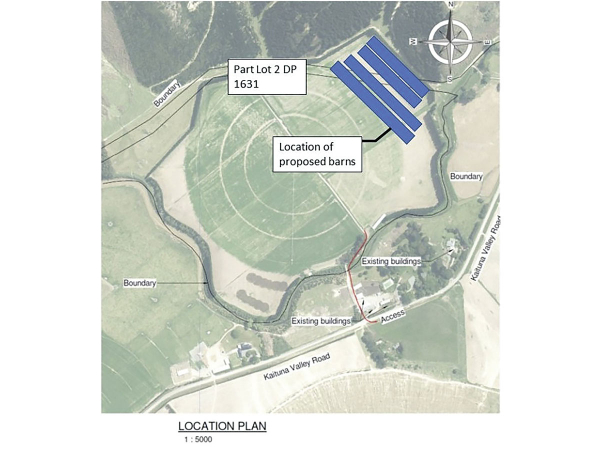 Wongan Hills has applied to Environment Canterbury (ECan) for consents to build four large barns on a farm in the Kaituna Valley.
A Canterbury farmer's plan to establish a 2,200-animal composting barn feedlot, near the environmentally sensitive Te Waihora/Lake Ellesmere, will go to a public hearing.
Farm company Wongan Hills has applied to Environment Canterbury (ECan) for consents to build four large barns on a farm in the Kaituna Valley, where owner Brent Thomas wants to house Wagyu beef for export.
The valley is a steep-sided catchment on the south east side of Banks Peninsula draining into the lake, which is only from 3km downstream from the proposed site.
Public notification of consents is only required in rare, specific circumstances. However, an ECan panel decided last December to put it to the public, mainly on the grounds of flood risk. The period for public submissions closed earlier this month and ECan consents planning manager Aurora Grant says 128 submissions were received, of which 28 want to be heard.
"We are still working through these," he told Rural News. "However, general themes include concerns over the flooding risk, impact on Te Waihora and animal welfare. The majority of the submissions received oppose the application."
Grant says a hearing, before independent commissioners is likely to be held before June with a decision due within 15 working days thereafter.
Among the most prominent opponents is the local community group Little River Eco Collectve. Its submission highlights five main objections. These include flood risk, and the risk of discharges, odour and dust affecting the highly sensitive environment as well as affecting local residents.
The group also claims the design of the barns is not well tested, while greenhouse gas emissions from the activity are inconsistent with policy and national directives.
Spokesman, University of Canterbury, Professor Donald Matheson says the group includes farmers and other rural people and it does not want to come across as anti-farming.
But he believes the development is in a valley where the flood risk is higher than the applicant's modelling, and only likely to get worse. The group submission claims floods with as severe impact on the site as its 200-year model predicts "appear to occur every two years".
It also says the model fails to account for the greater severity of flooding events in the context of climate change, "such as those associated with Cyclone Gabrielle, where 170% of 100-year flood levels was evident in some catchments".
"If you're going to do industrial-scale agriculture - 2,200 cattle in four large barns is quite a big development - it needs to be in the right place," Matheson told Rural News.
Thomas did not respond to a request for comment, but a document outlining a revision of the proposal, dated May 2022, describes a composting system that captures 100% of nitrogen effluent with no need for a liquid effluent system and therefore a reduction in N leaching.
Matheson says the idea of composting barns capturing nitrogen and reducing runoff is "great while it works" but there is a danger of them going anaerobic.
"If these things are not managed really well you have, not just the problem of cattle standing around in a field producing effluent, but you have a really concentrated problem of large amounts of effluent," he explains.
"The scale of this operation is large. The scale of the risk is really large."
Thomas says New Zealand can't compete with cheap beef from Chile and the US and our point of difference is high quality grass fed beef animals raised to high standards.
"We'd argue that New Zealand farming should think very carefully about building more of these beef farm operations that are running 24 hours a day," he adds. "We've had people in the farming sector saying this isn't the direction we should be going."
Members of the group have met with Thomas, his farm manager and consultants. But Matheson says they felt he (Thomas) treated it as an opportunity to reiterate his intentions rather than hear their concerns.
"There wasn't really a conversation there."
Wallaby control efforts in Canterbury have received a major boost, with Canterbury Regional Council releasing $2 million from its Pest Management Reserve.
Newly released data from Environment Canterbury (ECan) Farm Environment Plan (FEP) audits are showing a dramatic lift in environmental performance across the region.
Buying or building a rural or semi-rural property? Make sure you know where the wastewater goes, says Environment Canterbury.
OPINION: Canterbury grows most of the country's wheat, barley and oat crops. But persistently low wheat prices, coupled with a high milk payout, are believed to be driving farmers out of the industry in the hunt for the dairy dollar, according to media reports.
Environment Canterbury, alongside industry partners and a group of farmers, is encouraging farmers to consider composting as an environmentally friendly alternative to offal pits.



Ravensdown shareholders have elected Jane Montgomery and Kate Acland to the Ravensdown Board for three-year terms, following a closely contested director election.
Federated Farmers says new legislation replacing the Resource Management Act will cut red tape, unlock investment and help grow New Zealand's export-led economy, after the Planning Bill and Natural Environment Bill passed their third reading in Parliament yesterday.
Leading figures from the major political parties will be questioned on their primary sector policies at the Rural Issues Debate at Mystery Creek Events Centre, Hamilton, on 30 September.
OPINION: Have a plan in place now!
Beef + Lamb New Zealand (B+LNZ) says it welcomes the passage of the Natural Environment Bill and Planning Bill, calling the bills a positive step for sheep and beef farmers.
A spate of southerly winds bringing cold temperatures has presented challenges for Taranaki dairy farmers.