With drench resistance still a major problem on pastoral farms, reliable ongoing monitoring is a key component of keeping up the fight.
The faecal egg count in livestock enterprises remains one of the cornerstones of any parasite control programme, and its role in animal health and wellbeing is as important today as it has ever been.
What’s changing, however, is how farmers identify and count eggs and oocysts in a sample, buoyed by the support of AI, allowing analysis to work in the minutiae, including the micrometres of measurement and minuscule differences in egg morphology.
Splitting hairs at a microscopic level, analysis can now be repeated at scale, drawn from the smallest of images, to be repeated on an ongoing basis.
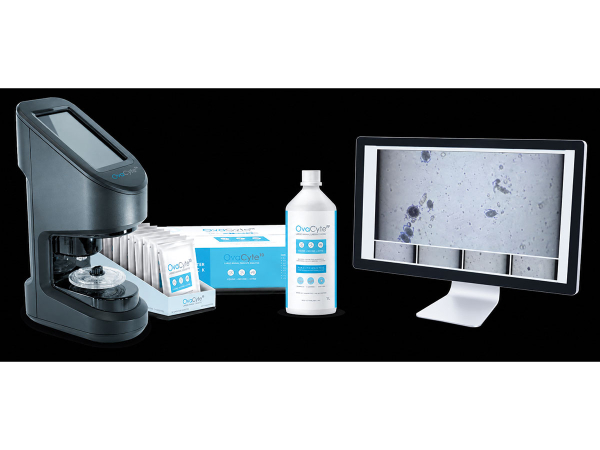
OvaCyte, manufactured by Irish company Telenostic, has already confirmed its position as a leading livestock faecal analyser, backed by scientific publications and a continued commitment to research in veterinary parasitology.
About to be launched in New Zealand in the coming months, OvaCyte Speciation now offers a world-first in parasite species identification from a faecal egg count, in minutes, at point-of-care.
The system comprises a rapid sample preparation process of approximately two minutes, complemented by a patented cassette into which the filtrate is loaded, and a benchtop analyser with an automated microscope.
Analysis is done in minutes with results displayed on the machine or the associated OvaCyte web app, accessed on a mobile phone, tablet or laptop. In total, sampling, preparation, analysis and results are delivered within 17 minutes.
Parasite identification and counting are performed by cloud-based artificial intelligence algorithms, requiring no technical training on the part of the operator. The result is a cost-effective, highly standardised, and validated method, supported by a growing body of peer-reviewed publications.
In practice, under the microscopic inspection, to the human eye, the eggs of Haemonchus contortus (Barber’s Pole worm) look almost the same as those of other strongyle worms. Barber’s pole worm is known to suck blood, cause anaemia and can kill ewes and lambs quickly, while also exhibiting a strong record of drench resistance.
Until recently, identification has usually meant sending samples away for larval culture or molecular testing and waiting a week or more for results. OvaCyte Speciation Ovine closes that gap, to deliver the world’s first automated point-of-care Haemonchus contortus detection solution, identifying Barber’s Pole worm eggs directly in the faecal sample, without the long wait.
OvaCyte Speciation also groups Eimeria, the parasites behind coccidia in sheep, and identifies coccidiosis in sheep. Sheep can carry many Eimeria species, but only a few can cause disease, so knowing what species are present allows farmers and vets to make an informed decision on whether to treat.
OvaCyte Speciation groups E. ovinoidalis, E. crandallis and E. weybridgensis together as “Type B” coccidia and reports them separately from the harmless species, direct from the faecal sample, resulting in another world first for the platform.
Jamie Fennelly, CEO at Telenostic, says, “Our goal is simple: give reliable answers quickly, so vets and farmers can treat the right animals with the right product at the right time”.
www.telenostic.com