FarmIQ Launches Free App for New Zealand Farmers and Growers
FarmIQ Systems has developed a free land management app to help remove barriers to New Zealand farmers and growers adopting digital tools.
 increase font size
 Farmax’s Gavin McEwen says farmers are concerned about who has access to their data.
Who has your data and what are they doing with it?
The question arises because more and more farm data is moving online, and its management needs to be secure.
Hence, as of early March farm data management firms are being accredited under the New Zealand Farm Data Code of Practice. The code sets the rules for how farmers' data is handled between various organisations.
Farm management software company Farmax, Hamilton, was the first company to begin the accreditation process, followed by farm information hub FarmIQ Systems, Wellington, and environmental management information host Gateway Data Services, Invercargill.
The code is one of three interlinked Primary Growth Partnership (PGP) farm data projects that will help make seamless data exchange in the agri industry the norm. The other two projects are the Farm Data Standards and Data Linker.
The Farm Data Standards project defines the various ways data can be exchanged between different farm software.
Data Linker, still in development but expected to launch soon, allows organisations to exchange data on terms agreed by both parties. Farmers are asked to give permission before any data transfer occurs.
Farmax Farmax general manager Gavin McEwen says farmers are rightly concerned about who has access to their data and how it was being used.
"Companies able to show their code of practice membership will help demonstrate to farmers that their data is being handled in a responsible and ethical manner," McEwen says.
FarmIQ chief executive Collier Isaacs says the accreditation scheme provides assurance to customers.
"FarmIQ has built integration with devices including Tru-Test, Gallagher, Iconix and Te Pari products, and has created data links with specialist software Cashmanager Rural for farm finances and feed budgeting with Farmax. This means users can easily move files and information, avoiding having to enter it twice and assisting accuracy and consistency."
Gateway Data Services managing director Janet Brooker says accreditation had been a thorough process.
"For Gateway Data Services accreditation confirms our investment in high level data encryption, gap redundancy and high end data integrity as the future standard for moving farm data. Excel spreadsheets and CSV files will no longer be acceptable," she said.
Software development specialists Rezare Systems at Waikato Innovation Park, Hamilton, were contracted to develop the code of practice.
It's one of the trio of related initiatives being worked on by Rezare.
Managing director Andrew Cooke says the code has sparked a conversation between farmers and their providers.
"The actual arrangements for rights to data and its use will vary depending on the type of data and who is paying, but clarity for farmers is crucial, because data is becoming essential for profitable farming," he says.
Federated Famers of New Zealand Dairy chairman Andrew Hoggard, who serves on the Farm Data Accreditation Board, applauds the first accreditations.
"Farmers are tired of having to supply data three, four or five times to different people," Hoggard says. "[The code] puts systems in place and gets the groundwork right."
Data guardians
The Farm Data Code of Practice defines disclosures and behaviours required of organisations storing, handling or moving data on behalf of New Zealand farmers.
The data governed by the code includes animal, land application, stock reconciliation, feed, grazing, irrigation, effluent, financial and chart of accounts data.
Compliant organisations will receive an annual licence, certificate and use of the Farm Data Code of Practice trademark. Participation is voluntary.
FarmIQ Systems has developed a free land management app to help remove barriers to New Zealand farmers and growers adopting digital tools.
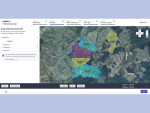
A step-by-step guide helping farmers through the process of creating a Freshwater Farm Plan (FWFP) has been launched by FarmIQ.
OPINION: The future of agricultural innovation is reliant on the sector being more open with its data.
The Farmax Landplane is a clever implement with many uses on farm.
Farm management software provider FarmIQ is shedding 25% of its workforce and adopting a new operating model to boost revenue.


Red meat farmers are welcoming Labour’s plan to review the Emissions Trading Scheme and not to campaign on pricing agricultural emissions.
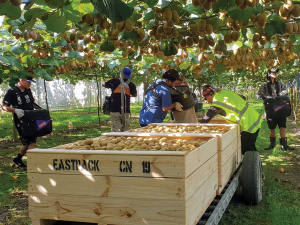
Where any worker in the kiwifruit industry is mistreated, we expect the authorities to take action.
Mid Canterbury Federated Farmers arable chair, Bevan Lill, said Beef + Lamb NZ data indicated that for the last six years, the average arable return on investment was about 0.8% while inflation ran about 4% - so the average arable farm was going backwards at about 3% a year.
Seed and grain companies share the concerns of arable farmers about the viability of their sector, says Seed and Grain New Zealand chief executive Dr Sarah Clark.
The New Zealand Institute of Forestry (NZIF) says unnecessary changes to New Zealand’s Emissions Trading Scheme (NZ ETS) will seriously erode investor confidence and result in significant reductions in forest planting rates.
For the first time in a quarter of a century, Federated Farmers has something positive to say about the Labour Party’s climate change policy leading into a general election.