NZKGI Responds to Migrant Worker Exploitation Reports
Where any worker in the kiwifruit industry is mistreated, we expect the authorities to take action.
 increase font size
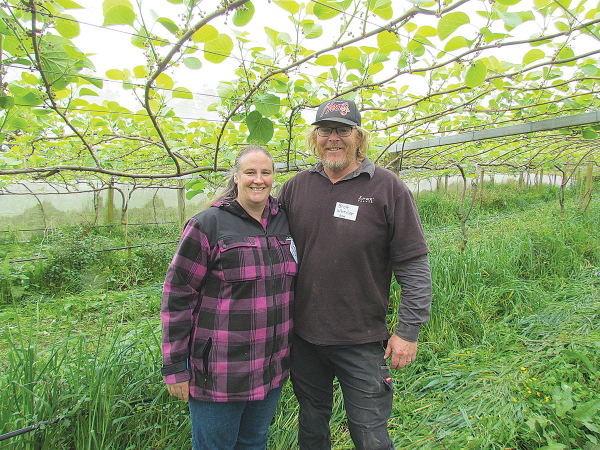 South Auckland kiwifruit growers Brett and Fenella Wheeler took out the supreme title in the Auckland Ballance Farm Environment Awards this year.
South Auckland kiwifruit grower, Brett Wheeler, jokes that some of the companion plants in his 13-hectare effective Glenbrook orchards are so large he has to take to them with a chainsaw.
But it's all part of improving soil health and biology, which has seen him and wife Fenella's BFG Kiwi take out the supreme title in the Auckland Ballance Farm Environment Awards this year.
At a field day at the end of September, Wheeler talked about changes on 8.3ha they bought in 2015. It was growing avocados, but they set about removing most of them to plant 2.6ha of Gold kiwifruit them more recently 2ha of Red.
While the Wheelers don't run an organic production system, they choose not to weed spray. No cultivation takes place after picking, which allows soil life to break down prunings left on the ground between the rows. Then after aeration oats are drilled which Brett says are the deepest rooting annuals, he could find from trials he's run over 10 years on their home orchard further west on the Manukau Harbour.
Tama ryegrass is also used with both crops singed by the application of Hi Cane he carries out himself. But these quickly bounce back and are allowed to seed so there'll be some regeneration for the next season.
Before pickers supplied by local packhouse, Punchbowl, arrive Brett uses a roller to knock the grass down for around a week while harvest is carried out.
They soil test once a year, with trials on their home orchard carried out over the last three years showing a big increase in soil organisms.
"There used to be no worms but now I can't count them, there's that many," Wheeler told Hort News.
They also regularly leaf test in order to adjust fertigation.
A Tailored Approach
Both of the Wheelers' orchards are fully mapped so a tailored approach can be taken to each plant's age, stage of growth and variety.
There are seven different sections to the orchards, with each having its own water meter and irrigation system controlled and monitored through a mobile app. Drippers have only been placed in every second row in the new orchard with water use able to be cut back because the ground cover means less sun getting to the soil so less evapotranspiration. From harvest to flowering humic and folic acid are applied as well as molasses, fish concentrate, seaweed and sea water.
This year, the Gold crop - in its third year - was picked early in the season and produced 13,500 trays/ha. This was well up on Punchbowl's average of 10,500. The Red part of the orchard produced its first crop of 5,000 trays. However, it was more affected by Cyclone Gabrielle with some 40-year-old Hayward rootstock which had been grafted over being wiped out.
"The water was knee deep for a week, so a lot of new drainage has gone in."
The orchard is all hail netted with flashing tape hung beneath it to keep any birds out. Landmarks are also placed above the canopy so pollinating bees can orient themselves more rapidly to get on with the job at hand.
To cut back on the pollen required they're in the process of building up their own orchard of male plants using the M36 and M43 varieties. Future plans also include removing more avocados and riparian planting along their 20-metre cliff face boundary.
Although not a dairy farmer Brett says he now wants to start replacing his herd - "some are getting a bit tired".
Where any worker in the kiwifruit industry is mistreated, we expect the authorities to take action.

Kiwifruit growers are watchful but remain optimistic as concerns around the potential effects of the El Niño weather pattern this season.
More signs of a booming kiwifruit sector.
After delivering a strong financial year, rural trader PGG Wrightson says the coming months will depend on customer confidence and weather.
New Zealand growers have always adapted to changing conditions, but one challenge is steadily gaining ground across the horticulture sector: resistance.



Wools of New Zealand chief executive John McWhirter says its new direct-to-consumer wool carpet service, Laneve, is the next step in the development of the business.

The New Zealand-India Free Trade Agreement entered into force today, improving market access for New Zealand businesses across a wide range of sectors.
Vetekina Pau'u is the first Tongan to win the William Gearish Memorial prize and sadly she will also be the last recipient.
Things are looking up in the dairy goat sector.
Mark Hooper has been appointed the new chair of NZPork, the industry organisation representing New Zealand pig farmers.
As the India-New Zealand free trade agreement enters into force, New Zealand’s apple industry has reaffirmed its commitment to the long-term development of India’s apple sector.