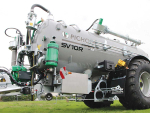
Pichon Adds SV10R and SV14 to SV Slurry Tanker Range
French manufacturer Pichon has expanded its SV slurry tanker range with the launch of two new models.
 increase font size
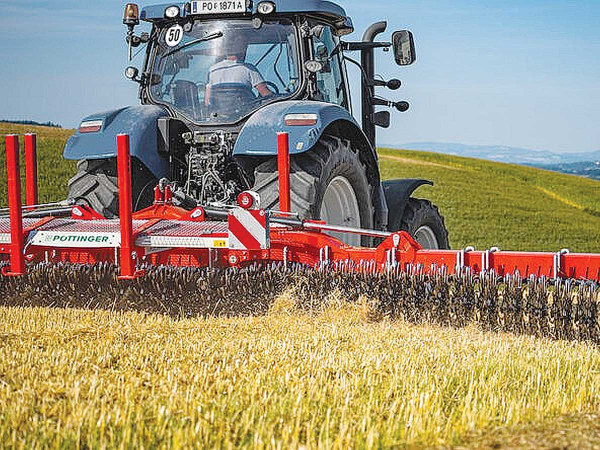 Pottinger’s new the ROTOCARE machines allow farmers to make the most of short, optimal time windows for mechanical weed control.
Pottinger has recently introduced mechanical crop care implements to its product range for sustainable, crop-specific and site-specific plant protection.
With the ROTOCARE rotary hoe and the FLEXCARE row crop cultivator, mechanical plant protection measures can be implemented gently and effectively.
Settings on the machine can be adjusted to handle different conditions. By operating the tractor lower links in the float position – in combination with depth control wheels – it achieves accurate ground adaptation. The position of the top link regulates the working intensity by adjusting the pressure on the rotary hoe stars, while the forward speed determines the aggressiveness of the process.
The row-independent rotary hoe stars sweep away weeds and their roots out of the soil and deposits them on the surface. The weeds are overturned and completely covered with earth, a lack of sunlight causing them to perish. In addition, any surface ‘capping’ is broken up to produce a crumbled effect. This aerates the soil, improves drainage and promotes nutrient mineralisation. Capable of working speeds of 10 to 30km/h and working widths of 6.6m to 12.4m, the ROTOCARE machines allow farmers to make the most of short, optimal time windows for mechanical weed control.
Settings on the machine can also be adjusted to handle different operating conditions. Many of these settings can be made without the need for tools. Different duck foot shares, weeding blades and following tools allow the machine to be optimised to the operating conditions. Various control systems help to ensure the best working results.
Different row crop cultivation effects can be achieved using FLEXCARE hoeing technology, separating the leaves from the root system. This row crop cultivator can handle row widths between 25 and 160cm, with each tool carrier able to be adapted for up to five hoe elements.
In addition, large, scalloped plant protection discs as well as finger hoes can be attached as following tools. A pre-set hole matrix and indicator scales on each component make it easy to set up all the tools identically.
An integrated hydraulic shift frame is standard and ensures convenient operation. The hydraulically controlled frame greatly reduces driver fatigue while maintaining a high level of precision.
By constantly adjusting the frame to the row, plant damage and crop losses are avoided while compensating for planting inaccuracies and maintaining a narrow hoeing band.
French manufacturer Pichon has expanded its SV slurry tanker range with the launch of two new models.
Recently revealed, Krone’s new Series Six, BiG Pack Plus and Pro balers are designed to use standardised components, interfaces, and control concepts, including pick-up, knotter systems and user interfaces.
Consuming around six years and more than 35,000 hours of physical and digital testing, the new sixth-generation Valtra T Series is being described as the most significant new release in the company’s history.
Strautmann has introduced a new Hay Edition auger for its Verti-Mix feed mixer wagons, aimed at operators using rations with larger proportions of hay or other long-fibre materials.
Austrian manufacturer Pöttinger has completed its fiscal year 2025/26 (ending 31 July) with what it suggests is a satisfactory overall result, with revenues of EUR 485 million, an increase of 5%.


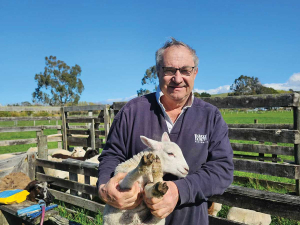
Decades piloting planes has ensured vet and farmer David Hayes is focused on safety. So, after a serious accident while welding on farm, he is sharing his experience so others can learn from it.

Canterbury milk processor, Synlait Milk has confirmed Leon Fung as its chief executive officer.
OPINION: Making it easier to collect rainwater and use it to grow crops and livestock is a no brainer.
As part of its Election 2026 coverage, Rural News asked political parties how they would help pull the arable sector out of the doldrums. Here's what they said:
Farmers are being encouraged to rethink how they manage waste on farm with the launch of ruralwastesorted.co.nz, a new website bringing together practical tips, real farmer experiences and resources.
New Zealand Winegrowers (NZW) is celebrating the India-New Zealand Free Trade Agreement (FTA) coming into force today, bringing New Zealand wine improved access to one of the world’s fastest-growing economies.