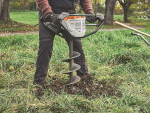
Stihl Launches BT140, Its First Battery-Powered Auger
With battery tools becoming more widespread and more importantly, productive and reliable, it was only time before we saw augers or post-hole borers.
 increase font size
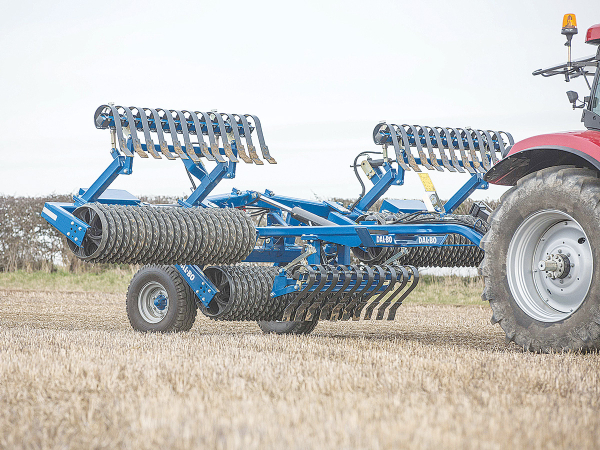 The Dalbo MaxiRoll is offered in working widths from 4.5 to 9.5 metres.
Rollers have been around in agriculture for more than 200 years, probably used initially for ‘flattening’ uneven ground.
However, during the last century these machines have been primarily used for pre and post-drilling consolidation to ensure good seed-to-soil contact and reduced moisture loss.
Danish company Dalbo, formed in the mid-1960s, has formed an excellent reputation in this field – not least for its extensive range of conventional and system roller offerings.
Imported and distributed in New Zealand by Cambridge-based Giltrap Agrizone, the Dalbo MaxiRoll is offered in working widths from 4.5 to 9.5 metres, although the focus is on the 530 and 630 models.
It is described by the manufacturer as a 3-point system roller constructed around a heavy-duty 150mm by 100mm steel frame carried on 400-60R 15.5 tyre equipment.
Each of the roller “gangs” is suspended under the frame with the patented DuoFlex-system, ensuring that each roller section works independently.
This is allowed by slots in the hydraulic cylinder attachment points to deliver optimal contact across the full working width.
Meanwhile, the hydraulic cylinders – working in conjunction with heavy-duty spring assemblies – create downward pressure and weight transfer of at least 500kg per metre, while also allowing the rollers to closely follow changing round contours.
The roller sections are made up of 55cm, patented Snowflake rings assembled between alternate breaker rings. The Snowflake name is derived from the integral spoke design within each ring, which is said to be like that of a snowflake crystal – with the radial spokes lining up with the high points of the roller circumference. The design is said to be six times stronger than earlier designs of Cambridge rings, meaning that Snowflake rings are covered by a six-year warranty.
Elsewhere in the construction, roller assemblies are carried on 60mm diameter chrome/ molybdenum steel axles, supported by heavy-duty greaseable bearings. The option of rubber suspended bearings are said to give a cushioning effect and help prolong the working life of the machine.
The system configuration of the rollers sees a hydraulically adjusted cracker board fitted ahead of the rollers. This features 80mm wide spring steel legs fitted with 100 x12mm curved blades or clod crackers. This is ideal to break clods and level the surface ahead of the rollers. The working angle of the tines is adjusted via turnbuckles, while depth is controlled hydraulically via a parallel swinging link suspension set-up.
With a transport width of only 2.5 metres, the 530 and 630 models weigh in at 3205kg and 4050kg respectively. When fitted with Snowflake rings (109 and 129 pieces), the horsepower requirement is only 90 or 100hp.
Standard equipment includes a parking jack and a road lighting kit. It also requires one double- and one single- acting remote for the base machine and an additional remote for the cracker boards.
With battery tools becoming more widespread and more importantly, productive and reliable, it was only time before we saw augers or post-hole borers.
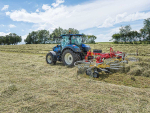
Austrian manufacturer Pottinger has released details of a new compact, linkage-mounted compact twin rotor rake, without a chassis, that is said to deliver impressive manoeuvrability.
The new Lemken Saphir XMR mechanical seed drill has been introduced as the successor to the proven Saphir 10m, with the manufacturer claiming new standards for precision, ease of use and area coverage.
Krone's XDisc 710 direct-cut header can now be used by John Deere and New Holland forage harvesters, as well as the Krone Big X it was originally designed for.
Fifty Eight years ago, on the 16th of August 1968, August Claas, the founder of the harvesting company and father of Helmut Claas, personally presented a Claas Senator combine harvester to Scottish farmer John Steven.


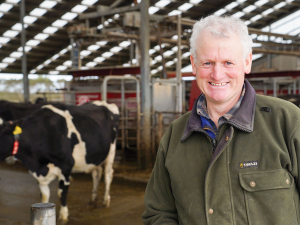
In Dacre, near Invercargill in New Zealand’s South Island, Bruce Dinnington is running a dairy operation unlike any other.

A free online platform aggregating governance vacancies across rural and regional New Zealand has been launched.
Environment Minister Nicola Grigg has announced details of a new rural plastics recycling scheme.
Agricultural drone operators say that a government decision to allow lower-risk drone work without certification won’t lower standards but drive innovation and efficiency.
OPINION: Warning bells are ringing in the arable sector.
Farmgate lamb prices are down by 8%, beef cattle by 4.5% and farm expenditure up by 4.2%.