New generation Defender HD11
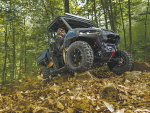
The all-new 2026 Can-Am Defender HD11 looks likely to raise the bar in the highly competitive side-by-side category.
 increase font size
 Can-am's new Defender.
Can-am off-road vehicles' reputation for performance and durability stems from its heritage of building snowmobiles for the Arctic Circle and the wildernesses of Canada.
So its launch of a sport/utility side-by-side called Defender had the opposition hoping it wouldn't be very good; alas it set a new benchmark.
Designed with input from users of such vehicles in New Zealand and Australia, the Defender is built around three tenets: tough, dependable and clever.
Designers and engineers spent a lot of time developing, testing and understanding farm users' must-haves – things as simple as somewhere to put staples during a fencing job, or somewhere for the dog to sit when the cargo tray is loaded.
'Tough' sees the use of proven V-Twin Rotax engines pushing out 50 or 72hp and said to have 20% more torque than its main competitors' engines. It has a tough chassis with 10 inches of suspension movement at each corner and 11 inches of ground clearance. The Pro-Torq transmission uses larger CVT ratios for a quick response, has a work-specific low gear for arduous jobs, electronic belt protection for overload, and an integral engine braking system for safety.
'Capable' sees the Defender achieving best-in-class towing, hauling and carrying statistics: towing capacity is 907kgs, the cargo bed is rated at 454kg and the payload is 680kg – scope for a load plus a couple of passengers.
The 4WD comes in 2x4, 4x4 and with the combination of an open or locked rear differential, allowing the driver to configure the vehicle for the ground conditions at hand. A claim to best turning circle in class (13 feet) is said to beat the sector's top selling competitor by a full 2 feet. An option of dynamic power steering eases tight turning.
'Clever' means a versatile cargo box with the lin-Q quick-attach system, tie downs and anchor points, plus a simple design detail in the structure of the body with pre-moulded rebates that accept dividers to create dedicated storage areas.
Storage in the cab includes a dashboard with cubbyholes on the upper surface, shelves and ledges below and the option of a removable carry box under the passenger seats. Without the carry box in position the seats flip up to allow a flat area for the farm dog.
The cab area is roomy, helped by a front roll frame designed to be 'pushed' forward to aid entry and exit and remove the risk of tall operators bumping heads on frames – often seen on more conventional layouts.
The maker thought hard about cost of ownership, resulting in a rear mounted engine accessed by simply tipping the cargo bed. Service interval is 200 hours or 3000km and warranty is three years and unlimited kilometres.
The NZ manager for BRP NZ, Richard Shaw, speaking on a dairy farm near Karaka, said the company had held competitive training days that had highlighted the daily uses and demands of side-by-sides on farms.
The Defender showed the best performance towing a loaded meal trailer, the best slow speed following of a herd coming to milking, the tightest turning circle and the lowest noise levels.
It also scored highly in offering space for man's best friend, and in having a master key to limit the machine's performance for inexperienced users or to achieve the best economy onfarm.
The all-new 2026 Can-Am Defender HD11 looks likely to raise the bar in the highly competitive side-by-side category.
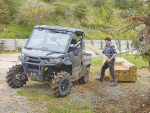
Can-Am will be using the upcoming Northland Field Days (Stand E6) to give farmers the opportunity to see the Defender HD 10 for themselves.
Can-Am is pushing the boundaries of performance with its Outlander line-up of all-terrain vehicles (ATVs) with the launch of the new 850 and 1000R models, said to offer industry-leading horsepower, increased suspension travel and refined handling.
Can-Am is pushing the boundaries of performance in its Outlander line-up of ATVs with the launch of the new 850 and 1000R models, said to offer industry-leading horsepower, increased suspension travel and refined handling.
Based on industry data collected by the Motor Industry Association, Can-Am is the number one side-by-side manufacturer in New Zealand.



LIC shareholders have elected a new North Island representative to the co-operative's Board, along with five representatives to its Shareholder Reference Group (SRG), following the company's Annual Meeting held in Invercargill.
Farmers across parts of Southland and South Otago are continuing to deal with difficult conditions after a prolonged run of wet weather, with pressure building around feed supply, stock management, pasture damage, farm infrastructure and everyday workloads.
Federated Farmers says it welcomes Labour's commitment to reviewing the Sharemilking Agreements Act, calling on other major parties to do the same.
For Canterbury dairy farmers Sian Meijer and Rick Wobben, wearable technology has become one of their most valuable on-farm tools - helping manage 1850 cows across an expansive, high-performing dairy operation while improving efficiency, mating outcomes and day-to-day decision making.
Fonterra has unveiled its annual results for the 2026 financial year, posting $27 billion in revenue and close to $20 billion returned to New Zealand farmer owners and unit holders.
The first major update to the Dairy Cattle Code of Welfare in more than a decade has been released, marking what DairyNZ describes as an important step in ensuring animal welfare standards continue to evolve alongside scientific evidence and on-farm realities.