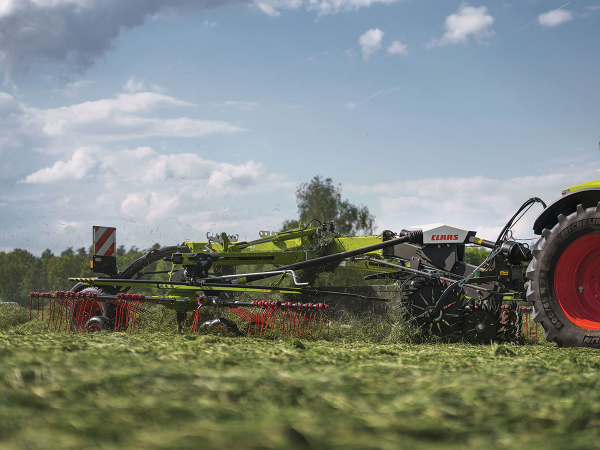
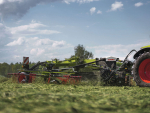
Twin rotor swathers have become the ‘go-to’ for forming swaths to feed hungry harvesters and balers, however, the design layout often means that crop located between the two rotors is not picked up, turned over or incorporated into the swath formed for subsequent harvesting.
Particularly when bringing three cut swaths into one, material gathered from either side by the rotors is deposited onto the untouched crop in the centre. This means that there is little or no drying effect, particularly in challenging crop types or damp conditions.
A new option from Claas, designed for the company’s LINER 3100-2600 twin-rotor rakes, sees a swath turner mounted beneath the drawbar and connected to the existing hydraulic circuit. It allows lifting and lowering at the headland, using the hydraulic circuit of the lift cylinders for the rotor arms.
Two pairs of twin, passively-driven star wheels pick up the crop under the centre of the swather and convey the material outwards, from where the main rotor tines lift and loosely incorporate it back into the swath in the direction of travel.
The incorporation promotes an airy placement that promotes even drying, but also ensures the swath can be picked up more effectively by following machines, as the stalks and leaves are no longer aligned lengthways but crosswise to the direction of mowing.
The wedge-shaped arrangement of the star wheels – smaller at the front and large diameter at the rear –utilise flexible spring steel tines, set in a flexible, resilient thermoplastic polyurethane (TPU) frame with adjustment in three dimensions, ensures a clean crop pick-up.
The easily adjustable coil spring suspension is complemented by standard plastic scrapers to prevent particularly long crops from being ‘dragged along’ before they reach the main rotors.
The company suggests that the option is suited in relatively delicate crops, such as alfalfa or clover-grass or during haymaking, where a consistent crop quality is required.
www.claasharvestcentre.co.nz