Synlait CEO Resignation Highlights Deeper Challenges Facing Dairy Processor
A revolving door of chief executives at milk processor Synlait is a warning sign, says Lincon University senior lecturer in agribusiness Nic Lees.
 increase font size
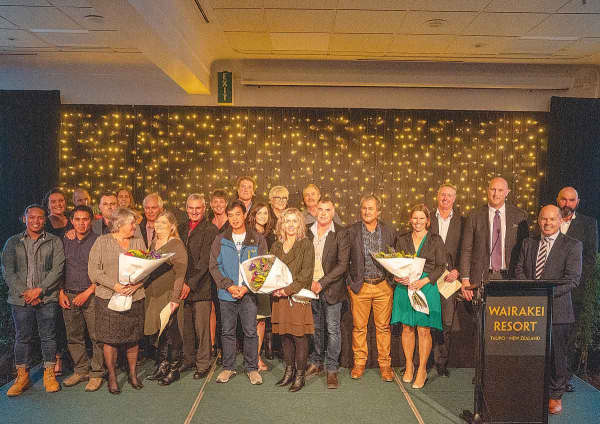 Miraka’s cream of the crop.
The goal of Māori-owned dairy company Miraka, near Taupo, is to become the most sustainable dairy company in the world.
That's according to chief executive Richard Wyeth.
Speaking at a special ceremony to recognise its top farmer suppliers, those who have met additional goals in the way they farm and in the quality of their milk they produce, under a scheme known as Te Ara Miraka (The Miraka way).
Wyeth says achieving high standards of sustainability starts behind the farmgate.
This means farmers applying environmentally sound practices to create climate resilient farms that produce some of the highest quality milk in the world.
Te Ara Miraka financially rewards any of its 101 suppliers who meet five criteria, namely – people, the environment, animal welfare, milk quality and prosperity.
Within these there are 31 standards of which 13 are mandatory for farmers to meet. These in turn are extrapolated out into a points system – 100 all told. If a supplier passes the mandatory measures, they get some sort of incentive, but if they get the full 100 points they will get the extra 20c/kgMS at the end of the season. This is pro-rated down depending on how many points a farmer gets.
This year, 18 farms achieved a score or 90% or more and five farms a score of 100%. This is twice the number of farms that have achieved this score since the scheme was initiated four years ago.
Supplier Wayne Chamberlin, of Chamberlin Trust Farm, says achieving the top score was a challenge.
“The Te Ara Miraka framework is good as it keeps you on your toes,” he says. “It incentivises you to keep striving and stay focused right through the season, and new measures are added each year. Miraka’s approach aligns well with our own philosophy on our farm.”
Chamberlin believes that if you look after the land and the animals, they will look after you.
Papatangi is one of five farms owned by the Te Raparahi Lands Trust. All five farms achieved an excellence score of 90% or above this season. Phillip Samuels says his trust is really proud to be suppliers to Miraka.
“They are proactive to deal with and have a genuinely personal approach,” he says.
“We never feel like we are being held back – Miraka encourages us to be innovative, to get out there and make things happen.”
Raising the bar
Miraka's general manager of milk supply, Grant Jackson says the aim of Te Ara Miraka is to get famers to raise the bar.
He says the goal is to make farmers strive for excellence in a wide range of areas including – animal welfare, sustainable land management and supporting staff.
“This is about more than just meeting regulations, it’s to show what’s possible and to become true leaders in the industry.”
Jackson says Te Ara Miraka is a dynamic programme. He says the pillars and criteria on which it was initially based will change so that farmers are incentivised to meet the new needs of consumers.
Jackson adds that Miraka stays in close touch with its markets and food safety is now a given. However, he says consumers are now looking closely at the environmental and social aspects of food production.
He says Te Ara Miraka is based on real data and consumers can have confidence in claims the company is making in terms of its products.
“It provides credibility. We have independent assessments that are ISO accredited and we validate that through our data bases and our GIS spatial mapping to state exactly what is happening on farm.”
A revolving door of chief executives at milk processor Synlait is a warning sign, says Lincon University senior lecturer in agribusiness Nic Lees.

Troubled milk processor Synlait has lost its third chief executive in five years.
Canterbury milk processor Synlait is blaming what it calls "a perfect storm" of setbacks for a big loss in its half year result for the six months ended January 31, 2026.
Farmers supplying milk to Taupo-based processor Miraka are getting a 2024-25 season base milk price of $10.16/kgMS.
Open Country Dairy has finalised a deal to acquire 100% of Miraka.

A safety push across New Zealand has revealed significant gaps in hazardous substances management, farm vehicles, tractors, quad bikes and side-by-sides.

New Zealand farmers have earned a global edge by consistently yet cautiously taking advantage of emerging agri-technology.
New season data from LIC shows a strong reproductive performance for the 2025-26 season, with a lift in key metrics compared to last season.
Xero, the global small business platform, today released its first ever small business productivity measurement backed by data from Xero Small Business Insights (XSBI).
Money invested to protect native bush, wetlands and other special habitats on farms is paying huge dividends.
A central Canterbury business which turns malting barley into a key ingredient in beer making has celebrated its 100% New Zealand-grown status with a special event.