NZ Forestry Exports to India Now Tariff Free
More than 95 per cent of New Zealand’s forestry and wood exports to India can now enter tariff free as the New Zealand-India Free Trade Agreement comes into force today.
 increase font size
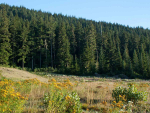
 Scientist and project lead Kathryn Walker is measuring how fast soil microbes are consuming methane by taking gas samples from field chambers installed in forests.
Scion scientists have embarked on important new research to find out how much methane is being consumed by microorganisms in New Zealand's planted forest soils.
Forest soils are good habitats for bacteria that absorb and release methane (CH4) as a source of carbon and energy. By quantifying how much methane is consumed by the bacteria, known as methanotrphs, at field sites, the project will reveal just how important planted forest soils are to New Zealand as part of broader efforts that seek to better understand the country's total net emissions and ways to mitigate climate change.
Once complete, the research will provide valuable insights for policy makers examining greenhouse gas emissions as it can be used to paint a more accurate picture of the country's total net carbon budget.
Due to agricultural activity, methane production in New Zealand is disproportionately high on a per capita basis - about six times the global average. Understanding the potential for other land uses, such as forestry, to mitigate these agricultural emission is critical, says Scion senior scientist Dr Steve A. Wakelin.
"We know that forests are great for storing carbon from carbon dioxide, but this research is helping us learn about forestry's capability to offset methane emissions as well. We believe it is a first step in a future programme of work that will demonstrate how different land uses in New Zealand are all inter-connected, and how to manage these holistically for win-win outcomes."
He says New Zealand's economy is reliant on the livestock sector for jobs, food and income. Scion's research aims to show how forestry can support the agricultural sector to tackle one of its biggest challenges.
"Scientist are working on breeding lower methane-emitting livestock, using methane 'vaccines' and inhibitors, and investigating farming system change such as feed and additives.
"However, even combined these are unlikely to 'nudge the needle' enough to meet our emissions reduction targets.
"As Aotearoa works towards a low-carbon future, this issue is one for us to tackle together."
The Ministry for Primary Industries is funding the research, with support from Lincoln University. It follows international studies proving that forest soils create optimal conditions for the methane-absorbing microbes.
As methane in the air passes over and diffuses within forest soil, methanotrophs consume the methane.
"We find methanotrophs are abundant in our DNA-based surveys of planted forest soils," Wakelin says.
"Indeed, based on overseas systems, it turns out that planted forest soils are pretty good habitats for methanotrophs; we just haven't looked at this in New Zealand before."
Scion's Microbial Ecology - Soil Systems team is now collection New Zealand's first field-based measurements of methane flux - how fast the soil microbes are consuming methane.
Researchers have installed methane flux chambers at two field sites near Christchurch: Orton Bradley Park and McLeans Island. At both sites Scion already collects environmental DNA and measures environmental properties; this information will now be integrated with the methane flux data. Chambers have also been installed in Kaingaroa Forest in the central North Island - New Zealand’s largest commercial pine plantation.
Sampling of these field chambers will reveal how much methane the forest soil microbiome is consuming over an entire year.
“If rates of consumption are high, we need to know as this data will be important for our national carbon budget,” says Wakelin.
"Given the importance of methane as a greenhouse gas for agriculture, it could just be a case of forests to the rescue.”
Lincoln University’s Prof. Tim Clough says the collaborative research with Scion will reveal important data.
“With Scion’s expertise in forestry aligned with Lincoln University’s facilities for tracegas sampling and analysis provided through the New Zealand Greenhouse Gas Centre, we have a great partnership in place to assess the big opportunity of forest methane consumption.”
Methane is responsible for about 25% of global warming. What’s more, each molecule of methane has about 28 to 35 times greater warming potential than carbon dioxide (CO2). This means that concentrations of methane in the atmosphere have considerably more potential to alter climate change compared to the same volume of carbon dioxide.
More than 95 per cent of New Zealand’s forestry and wood exports to India can now enter tariff free as the New Zealand-India Free Trade Agreement comes into force today.
The New Zealand Institute of Forestry (NZIF) says unnecessary changes to New Zealand’s Emissions Trading Scheme (NZ ETS) will seriously erode investor confidence and result in significant reductions in forest planting rates.
New Zealand needs to make sure that it continues to focus on its own food security, according to HortNZ board member and blueberry grower Dermott Malley.
Bank of New Zealand (BNZ) and Pāmu (Landcorp Farming Limited) have developed a new way for landowners to earn revenue from existing native forests.
Forestry Minister Todd McClay has today congratulated the winners of the 2026 Growing Native Forests Champions Awards at Fieldays.



Three men have been sentenced in District Courts after Ministry for Primary Industries prosecutions over animal welfare, food safety and cattle tracing offences.

Fonterra’s 2026 financial year was a year of delivery, with record volumes of milk collected, processed and shipped by the co-op.
OPINION: The Government's decision to reinstate agriculture and horticultural science as a standalone subject from Year 11 is the right one.
Dairy farmers, still holding onto their Fonterra shares despite switching milk supply elsewhere or exiting the industry, now face a stricter share sell-down requirement.
Hamilton-based agritech company Aimer Farming has completed a $3 million capital raise to support its next stage of growth, including a beef farming product due to launch in 2027.
When dairy manager Miriam Lauridsen learned the farm, she was joining held weekly health and safety meetings, she initially thought that was “a bit over the top”. Experiencing that culture changed her mind.