Editorial: Stay the Course
OPINION: The United States wine market has changed forever, and companies cannot use same old playbook, said Erin Kirschenmann at the New Zealand Wine 2026 Wine Business Forum in August.
 increase font size
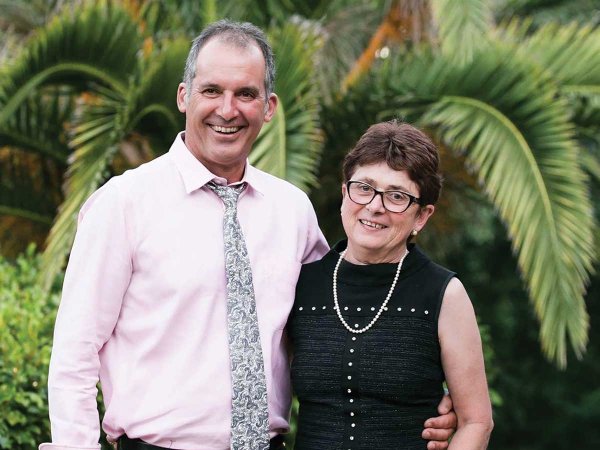 Rex and Maria Sunde
In a classic story of poacher turned gamekeeper, Rex Sunde ditched a career in agrichemicals to help New Zealand winegrowers minimise their spray use.
"The more I got to understand and know that business, the more I felt I didn't belong there," he says of five years working with a German agricultural company.
Fast forward 45 years, via kiwifruit sales, wine importing, an organic vineyard, viticulture consultancy and 17 years of invaluable work on the New Zealand Winegrowers Vineyard Spray Schedule, and Rex has been named a 2026 NZW Fellow for his services to viticulture and sustainability. "I think it's very cliche, but you just do feel immediately humbled and grateful," says the former NZW board member, NZW research committee member, and OWNZ executive committee member. "It's totally unexpected, but joyful."
Growing up in Oratia, West Auckland, Rex spent his time fossicking for semi-precious rocks, as a self-described rockhound. When he told his parents he wanted to be a jeweller, they told him there was no future in it, Rex says, noting that a young Michael Hill was making plans around the same time.
Geology was the next best thing, but he was deterred by the maths, so instead followed the lead of his grandfather, Dick Sunde, who was a "terrible winemaker" but extraordinarily kind, says Rex. Dick and his brothers emigrated from Dalmatia in 1906 and settled in Oratia, where they made wine "in the traditional Dalmatian way, which was more water than grapes", Rex says. When Rex was a teenager, his father took over the business and pulled out the small vineyard, but Dick's influence had taken root, and Rex went on to study horticulture and viticulture at Massey University, where, perhaps unsurprisingly for a teenager oft looking groundward, he excelled in soil science.
His first job was with Arthur Yates & Co, which fuelled a "nerdy" fascination with plant breeding. Then, in the early 1980s, he began work for a German agrichemical company. Within four years he had progressed from technical officer to head of department in New Zealand, with frequent trips to Germany and elsewhere "to learn the trade", he says. "But I just had an epiphany one day, and came home and said to my wife, 'I'm nothing more than a rat poison salesman and I don't like this. I don't belong here'."
In 1985 he joined the kiwifruit industry in its "golden days", and within a year was living in Europe, setting up the first New Zealand kiwifruit sales office there. It was an influential time for Rex. "I've always maintained that the Europeans were, and still are, the absolute world leaders in thinking about how to manage the tensions between mass food production and healthy food production," he says. It was a learning that would come into play when he started working on thee NZW Spray Schedule, questioning how New Zealand could produce wine that is "unquestionably fit for market".
After three years in kiwifruit, Rex had a "very brief spell" selling wine, buying a "rundown wine shop" and importing Eastern European wines before the Iron Curtain fell. Then in 1992 he began working as a viticulturist for Nobilo, where he stayed for eight years. He credits Mark Nobilo for teaching him how to communicate with growers and write things in a way that was simple and practical. Rex describes himself as being "on the spectrum... very nerdy and very shy". Mark gave him confidence and skills to share his knowledge, he says. "I am incredibly indebted to him."
The learnings were invaluable when he set up his own viticulture consultancy in 2000. Giesen Wines was his first "anchor client", and Theo Giesen was so impressed with his spray schedules that he showed Philip Manson, who was NZW Research and Sustainability Manager at the time. Rex subsequently became the face behind NZW's Vineyard Spray Schedules from 2007, merging the "clarity, simplicity and good messaging" he'd learned at Nobilo with his deep understanding of agrichemicals. He and his colleague Gillian Howard, who provided vital "structure and logic" to the work, brought greater sophistication to the schedule, including ensuring companies had an option to produce wine with no residue, rather than simply complying with maximum residue limits. "We took the spray schedule from a list of chemicals that you could use, to a document that enabled you to safely enter whatever market you wanted to."
Rex also saw the looming risk of spray resistance and, on the flipside, the potential of having spray efficacy outlive patents, given the distance of New Zealand vineyards to resistant pests and diseases. If growers could use sprays optimally, the industry could stretch the life of agrichemicals beyond the life of patents, meaning they would get a lot cheaper.
He worked with the Sustainable Winegrowing New Zealand team on a resistance management programme, including alternating products with different modes of action to reduce the opportunity for resistance. It can be "terribly complicated", but the programme sets out a pathway that growers can follow, "saying you select what you like, but you can't select this more than three times, or you can't select that more than four times, and you can't mix this with this." SWNZ coupled that advice with the questionnaire and spray diary, so that when growers enter their spray applications during the season they'll be alerted if their chemistry doesn't fit the programme, Rex says. "I actually think it's world leading."
While Rex was at Nobilo, he and his wife Maria planted a vineyard on their Fantail Island property in Oratia. They established Artisan Wines in 1999 and by 2014 had full BioGro organic certification. "I think you come to a realisation that you have a duty to leave your land in a better condition then you started with it," Rex says. "I just wanted to be a good kaitiaki of my land."
It was also an opportunity to use his understanding of soils and disease mitigation to answer questions about organics. "I had as much knowledge as anyone else in the country in terms of what chemistry to use and how to use it, so I overcame my fear of that and realised that the big challenge in organic viticulture is actually nutrition and weed management." He was on the OWNZ board during that period, and endeavoured to help educate others about what they could do with organics. "I took a lot of pleasure out of being able to share my knowledge."
But it also proved a smart business decision, as an appealing factor of their small winery and cellar door on the outskirts of Auckland. "It really did enable us to have a point of difference, to open doors that were previously not open to us, and to maintain a price difference."
Rex values his role in the wine industry, and on the spray schedule in particular. But it was also a period of "tremendous self-doubt and depression", he says. "I never felt worthy, I never ever felt capable, and I ended up with tremendous depression." Being named a Fellow has made him reflect on the precarious nature of his wellbeing at that time, and question whether he can help others in the current tough times. "I imagine there's a lot of depression out there, and I wonder if there is something I can do to facilitate that recovery." His own wellbeing, he says, required "the whole nine yards" of counselling, medication, "and tremendous family and friend support".
In 2022 the Sundes pulled out their vineyard and these days Rex is "retired-ish", only taking on work he enjoys, like working with the Cropsy Technologies agritech startup, with its AI-powered vineyard monitoring system. "I'm working with young people who are at the forefront of technology... and I love helping them in a little way."
But it's perhaps more likely Rex the rockhound will be found foraging far-flung places for semi-precious stones and fossils, or silversmithing them into jewellery. There is, it turns out, a future in it.
OPINION: The United States wine market has changed forever, and companies cannot use same old playbook, said Erin Kirschenmann at the New Zealand Wine 2026 Wine Business Forum in August.

The inaugural winners of the NZ Dairy Awards’ CowManager Experience prize say it will be a no-brainer to keep the technology in their farm business after experiencing the results.
For the past 35 years, Philip Gregan has helped select New Zealand Winegrowers Fellows, working with the board to choose a cohort of extraordinary industry champions.
Lynnette Hudson's 30-year obsession with Pinot Noir was sparked working vintage in Burgundy, seeing how subtle changes in terroir were expressed in the glass. It was, she says, "an elightening moment in every way".
Winemaking and photography each require an understanding of science, says Kevin Judd. But the final product is judged by someone else’s senses, “so they’re both an art”.