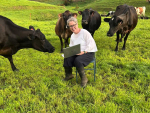
International Day of Rural Women: Two DairyNZ Farmers’ Stories
Today, 15 October, is the International Day of Rural Women, which recognises rural women’s contribution to farming, communities and the environment.
 increase font size
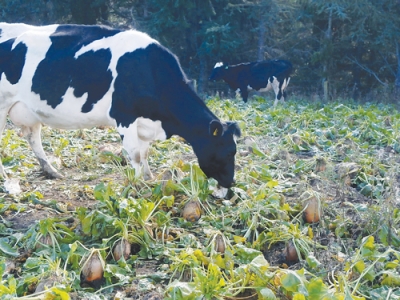 Beets have become popular feed for cows.
DairyNZ scientists are urging farmers to take care when feeding fodder beet to their dairy herds this winter.
The caution comes as vets report increased issues with cows becoming ill or even dying as a result of problems experienced on fodder beet crops.
Beets have become increasingly popular over the past two years because they are high yielding and are suitable as a supplement for dairy herds. They are particularly popular in Southland and Canterbury, but are now being grown in North and South Island.
Despite being an excellent source of metabolisable energy, there is concern that some cows are getting too much of the high sugar crop in their daily feed intake or are not getting sufficient time to adapt to fodder beet as part of their winter diet.
“We have had reports of farmers offering cows unlimited access to fodder beet. Because of its high concentration of sugars, fodder beet is a feed that should not be offered in this way,” says DairyNZ nutritionist Dr Jane Kay.
DairyNZ senior scientist Dr Garry Waghorn says fodder beet’s high sugar component means that excessive intake of beets can lead to lactic acid production in the cow’s rumen, and cause acidosis.
The transitioning stage for fodder beet becoming part of the cows’ winter diet is critical to ensuring that cow health and the nutritional value of fodder beet are optimised.
Waghorn and his associates at DairyNZ have run trials on the impact of fodder beet feeding. They have found that even following the recommended transitioning over 14-21 days some cows could not cope with high levels (>70%) of fodder beet in the diet.
“Cows vary in the rate at which they adapt to a new feed type and in the amount they can eat. Move too quickly or feed them too much and you will kill some of them,” Dr Waghorn says.
The DairyNZ trial work found that cows need to be transitioned carefully onto the crop over a 14-21 day period.
A typical transition would involve ramping up the fodder beet input by an additional 1kg DM/cow every second day, from a starting base of 2kgDM/cow/day.
DairyNZ trials at Lincoln transitioned cows at an average of 0.5kgDM/cow/day, taking 17 days to get them up to their 8kgDM/cow/day allocation.
Waghorn said it was critical to ensure that cows were also offered sufficient silage, hay or straw before feeding the fodder beet, to slow down their intake of fodder beet.
Once transitioned it was also vital that farmers continue to pay attention to the proportion of fodder beet in the diet.
“At one stage in our trials we had cows eating 85% fodder beet and 15% straw. Half of these cows became sick, required treatment and had to be taken off the diet.
“This was in a controlled environment, and he emphasises the importance of offering enough supplement to a herd to ensure all cows achieve adequate intakes to avoid acidosis.
“This trial work has shown that the herd should not be offered more than 70% of their diet as fodder beet. The remainder of the diet should be a long fibre source,such as silage, hay, or straw, and the cows should be fed this before their beet.”
This is about 8kgDM/cow/day in beets, and 4-5kgDM/cow/day of the other feed(s). “If you go over 70% fodder beet, you could kill some of your cows,” said Waghorn.
Good practice in managing a herd on fodder beet also requires that farmers accurately measure the crop yield. This includes knowing the percentage dry matter offered in each break, and remembering that this can vary within and between paddocks.
It was important that the cows grazed a ‘mix’ of the roots and tops, and care was needed to ensure cows were eating the entire break offered, and uneaten beets were not accumulating behind them.
“Every cow is unique and will adapt to the fodder beet diet slightly differently. Our trial showed that even a well-planned transition can result in acidosis and if cows are fed more than 70% of their diet as beet, half the herd are at risk of acidosis.
Today, 15 October, is the International Day of Rural Women, which recognises rural women’s contribution to farming, communities and the environment.
The first major update to the Dairy Cattle Code of Welfare in more than a decade has been released, marking what DairyNZ describes as an important step in ensuring animal welfare standards continue to evolve alongside scientific evidence and on-farm realities.
Have a plan in place for your cows and staff.
Bovine Viral Diarrhoea (BVD) is sometimes viewed as a dairy industry issue, but the reality is that the disease can have serious consequences for beef breeding herds as well.
DairyNZ deputy chair Cameron Henderson has been re-appointed unopposed for another term.


Farmers are being encouraged to rethink how they manage waste on farm with the launch of ruralwastesorted.co.nz, a new website bringing together practical tips, real farmer experiences and resources.

New Zealand Winegrowers (NZW) is celebrating the India-New Zealand Free Trade Agreement (FTA) coming into force today, bringing New Zealand wine improved access to one of the world’s fastest-growing economies.
New Zealand’s red meat sector has welcomed the India-New Zealand Free Trade Agreement taking effect, which removes India’s 33% tariff on New Zealand sheepmeat.
More than 95 per cent of New Zealand’s forestry and wood exports to India can now enter tariff free as the New Zealand-India Free Trade Agreement comes into force today.
Federated Farmers is backing Feilding High School’s call to keep Agriculture and Horticultural Science as a standalone subject in Year 11.
Food and fibre exports have returned a billion- dollar bonus to the country.