Boosting Crop Production by Spreading Effluent
Tararua district farmer Jamie Harris milks around 400 cows using a split calving system on his farm, Crossdale Dairies.
 increase font size
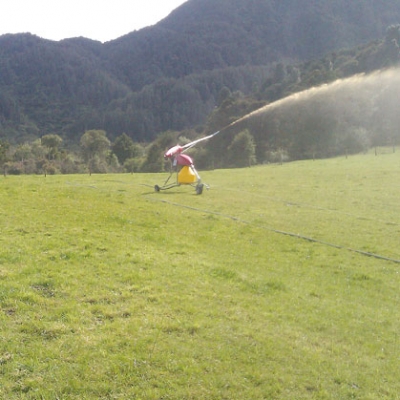 The pond mixer and irrigator must work together.
On the need for water: don’t you wish you had a bit more water to keep pasture alive? Were you one of those farmers who strove to build an effluent pond of minimum size, and so missed out on having extra water in this year’s dry season?
Remember, half the rainwater that falls on your property runs off in winter. Think about ways to retain it so that you can at least keep grass even just alive in summer. If you have to re-sow dead pasture, it will be two years before the grass is producing at full bore.
On the other hand, dormant grass kept alive with even small amounts of moisture will burst into life again when the rains come. So it could be false economy to skimp on pond size. A bigger pond implies a better level of insurance by lowering risk.
On the need for plenty of water: a second factor in effluent spreading is dilution.
Any good gardener will tell you that animal manure is far better for plants and soil organisms when it is applied in a diluted form. It won’t kill the worms at least, and they are just the organisms you can see. Still scared of storing rainwater which dilutes your yard washings and helps grow pasture? Don’t be, there are benefits.
On the uniformity of spreading: stir a pond with a tractor or floating mixer and you get odd effects. Effluent concentrates in the least active zones of the mixed pond. In the tractor-created vortex, the sludge builds up like a volcano in the centre of the pond. For the floating mixer, the buildup is in any quiet zone of the tank or pond. You can’t see this effect, but it is happening under the water. Now, when you pump the pond out, the irrigator gets a thin mixture followed later by a concentrated mixture. Thus one paddock gets weak manure and the other gets stronger manure. Few farmers think about this, and your system designer probably overlooks it too. It’s pointless sending inconsistently mixed effluent to your super-duper evenly spreading irrigator. Your pond mixer and irrigator should be working together to spread this stuff uniformly over the pasture.
On centrifugal pumps versus progressing cavity pumps: if you want the same irrigator performance (within a few percent) from each hydrant on your farm, you’ll be hard pressed to achieve it with a centrifugal effluent pump – even the higher pressure versions. Chances are they’ll give plenty of flow at the hydrants near the pump, but then the flow will diminish at more distant hydrants and those up the hill. It’s just a characteristic of the pump. The progressive cavity pump will deliver almost the same flow to every hydrant – near and far. This will mean irrigator performance will be the same at each hydrant. Isn’t that what you want?
On irrigator speeds: “Our irrigator has seven speeds,” says the manufacturer. “Yes, I know,” you reply, “but what amounts of liquid are actually delivered at these differing speeds?” The response will probably be evasive. The speeds will change as the rope winds onto the drum, or as pressure varies, or as hose load changes. It’s time manufacturers were required to have their machines evaluated comparatively. If your fertiliser spreader spread fert as variably as most irrigators do, you’d fire him. Why is your standard lower for irrigators or solids spreaders? So much for scientific farming.
Tel. 04 586 3411
• Stuart Reid is principal of Spitfire Revolution.
Tararua district farmer Jamie Harris milks around 400 cows using a split calving system on his farm, Crossdale Dairies.
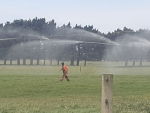
Water management is an integral component of sustainable farming practices, according to Watermetrics.
Two farmers and two farming companies were recently convicted and fined a total of $108,000 for environmental offending.
A Taupiri farming company has been convicted and fined $52,500 in the Hamilton District Court for the unlawful discharge of dairy effluent into the environment.
Founded in Germany as recently as 1977, today, the Fliegl Group employs more than 1100 workers, offering an expansive range of transport solutions, from their base in Bavaria.


Leading figures from the major political parties will be questioned on their primary sector policies at the Rural Issues Debate at Mystery Creek Events Centre, Hamilton, on 30 September.
Beef + Lamb New Zealand (B+LNZ) says it welcomes the passage of the Natural Environment Bill and Planning Bill, calling the bills a positive step for sheep and beef farmers.
A spate of southerly winds bringing cold temperatures has presented challenges for Taranaki dairy farmers.
Converting a longstanding cropping farm to dairy was the only way to ensure the land stayed in the family long term, says new dairy farmer Rod May.
As the election heats up, Organics Aotearoa New Zealand (OANZ) has launched its election scorecard designed to help voters wanting to support policies that grow organic and New Zealand's organic sector.