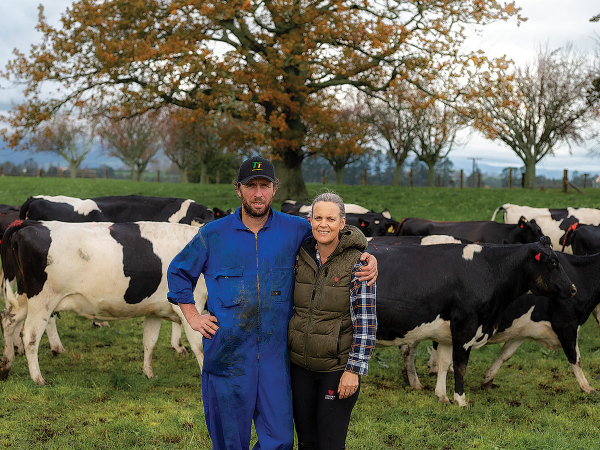
The Hinuera couple, who milk 360 cows on their 120ha property, have been using CowManager ear sensors in their herd for the past five seasons, embracing the technology as a way to improve herd management, streamline mating and remove bulls from the farm altogether.
“We didn’t want to have bulls on the farm anymore,” Toby says.
“We’d had some Angus bulls cause a bit of damage around the farm, and bulls riding cows on the yard caused lame feet and all the other hassles.”
The couple was first introduced to the system through a neighbouring farmer who had been using it successfully for a few seasons.
“He was pretty impressed with both the system and the service,” Toby says.
“It was also a bit more cost effective than some of the other options out there.”
For Toby and Jackie, their careers in dairy farming have not been linear. Although both grew up on farms, they worked in off-farm jobs for several years after they finished school before they found themselves back farming – this time, together.
Today, they are in their eighth season farming at Hinuera, where they calve 360 cows producing approximately 184,000 kgMS annually. They employ one staff member and have built a business centred around efficient management, strong breeding decisions and a passion for Holstein Friesians.
Their journey into farm ownership was not without calculated risk. After seven years sharemilking 300 cows, the couple found themselves struggling to secure another sharemilking position and decided the best option was to purchase a farm themselves.
To make it happen, they made an assertive decision.
“We kept all the old budget cows and sold the top two thirds of our herd,” Toby says.
Their first property was an 80ha farm on Horahora Road, along the Waikato River, which they owned for five years. During that time, they did subdivision work that ultimately helped them purchase a larger farm.
“We bought the land as one title and sold it as three parcels of land,” Toby says. “We were able to make a bit of pocket money that allowed us to purchase a larger farm.”
That larger farm was their Hinuera property, which is currently undergoing an intentional breeding programme to bring the Friesian-cross herd back to where Toby and Jackie like it best – traditional Holstein Friesian-type cows.
“In the past we chased BW a little bit, but we didn’t like where those breeding choices were taking us,” Toby says.
Today, the herd is heavily influenced by US Holstein Friesian genetics. All cows are mated to US-based Holstein Friesian sires, while heifers are mated to an even split of US and Kiwi genetics.
The breeding programme carefully balances functionality with type and production traits.
“We’re looking for cows that aren’t too tall,” Toby says. “Udder traits and general conformation are important, and we tend to go for top-end fertility bulls as well.”
Calving begins July 1, with the couple rearing 115-120 heifers annually. About 85 replacement heifer calves are retained each year, while around 30 genomically-selected heifers are sold from the lower end of the herd.
The mating programme itself is highly structured. Although “a few special heifers” are mated a little earlier, according to Jackie, the majority of heifers begin mating on September 25, with the cow herd starting on October 2. The entire herd is mated via AI over an 11-week mating period. Around 30% of the herd is mated to beef sires. Among the sires to leave a strong impression on the herd are Sandy-Valley Icarus-ET and Progenesis Wimbledon. The O’Reillys have several Icarus daughters milking, and a large group of Wimbledon progeny are looking particularly promising.
“We’ve got a big line of 18 A2A2 Wimbledon heifers coming through and they’re streets ahead of the other two-year-olds,” Toby says.
The introduction of CowManager technology five seasons ago has significantly changed the way Toby and Jackie manage mating. The system continuously monitors cow activity and health through ear sensors, sending real-time information directly to their phones and computers.
“It’s made it far easier to pre-empt mating heats,” Toby says. “You’ve got the data right there at your fingertips. It’ll identify cows cycling, even when they’re not outwardly showing any signs.”
The technology has also proven valuable for the embryo work they undertake within the herd. “When we’re picking recipients, all the information is available,” Toby says. “It makes that side of things very reliable.”