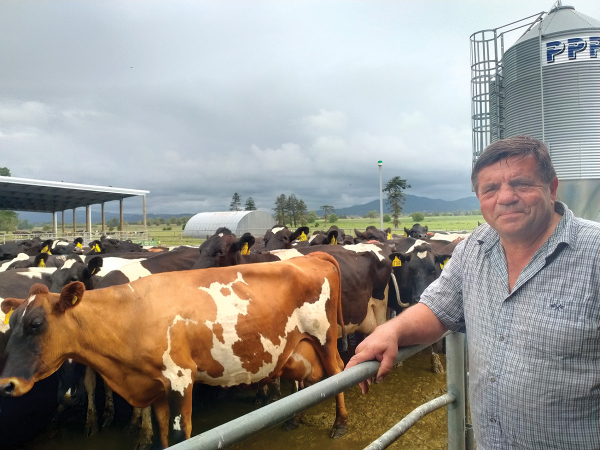
His persistence is paying off with Fonterra announcing that from 1 June 2026, its milk price will start to be split into fat, protein and lactose rather than just the current fat and protein.
Van Beek told Dairy News that he was relieved that a lactose payment will be introduced in the new season.
"I thank Fonterra staff who prepared the first principles financial model used in this milk payout evaluation cycle.
"They were able to break away from the existing model dominated by a historic genetics' paradigm centred on milk fat and protein rather than trueful valuation of all milk components."
A Fonterra spokesman told Dairy News that the addition of lactose from the 2026-27 season is about fine tuning the framework that's used to distribute the farmgate milk price so that it's more precise and fairer in terms of recognising the underlying value of the different components of milk supplied to the co-op.
About 85% of milk is composed of water. Approximately 5% is lactose, with fat constituting 5% and protein about 4%. The rest is minerals and vitamins. These percentages are based off co-op averages over recent seasons.
He says the variability of lactose content across different milk profiles is relatively limited, and this tight range makes it the least variable of all the solids within milk.
"Because of the limited variability of lactose across milk profiles, for the vast majority of farms there will only be a small impact or no impact from this change."
Preparing for the inclusion of lactose in the milk payment, New Zealand Animal Evaluation, a subsidiary of DairyNZ, has amended economic values (EVs) as part of the December 2025 Animal Evaluation run, ensuring the breeding worth (BW) index continues to reflect current farm conditions and milk payment structures.
Each year, the EVs that underpin BW are reviewed to ensure they capture the latest on-farm costs and returns New Zealand dairy farmers face. The updates, which went live last week, help maintain the accuracy and relevancy of BW - the index used to rank cows and bulls on their ability to breed efficient and profitable replacements.
NZ Animal Evaluation Manager Andrew Fear says the annual update process keeps BW aligned with changing market realities.
"Breeding Worth is a vital tool for farmers, providing an independent measure of genetic merit that links directly to farm profit. These annual updates ensure it remains current and robust, helping farmers make confident, future-focused breeding decisions,” says Fear.
“For farmers, these updates ensure that the BW rankings they use to guide breeding are grounded in the most up-to-date economic conditions and milk payment structures. This helps with herd profitability, resilience and efficiency, as the market evolves.”
Fonterra strategic advisor Malcolm Ellis says the co-operative’s decision to add lactose into the framework that’s used to distribute the Farmgate Milk Price is about recognition of value.
“The value assigned to each component of milk is largely driven by supply and demand dynamics, with fat and protein continuing to contribute the vast majority of a farmer’s milk revenue,” says Ellis.
“Lactose also has a value, and Fonterra is fine tuning its parameters from the 2026/27 season to reflect this – where milk price payments will start to be split into fat, protein and lactose. For most farms, there will only be a small impact or no impact from this change due to the limited variability of lactose across milk profiles.”
Valuable Ingredient
Gerard Van Beek says that in 1980 the New Zealand Dairy Board coined the term milksolids which incapsulated milk fat and protein.
He says this formed the basis of the ‘A+B-C milk payout’ model that has been used by most dairy companies ever since.
When the current Breeding Worth model was introduced in 1996, it calculated the efficiency of farmers converting feed energy to farmer profit.
“Because lactose did not form part of the payout model, it was determined that it had no economic value at the farm gate,” he says.
“This led to lactose feed energy being lumped in with the volume economic value. This ignored that lactose revenue was lumped in with the protein payout value. This led to a gross under allocation of feed energy to the overvalued protein economic value and a massive penalty in volume economic value.
In 1999 the CODEX for the manufacture of milk powders changed and allowed milksolids (lactose and minerals) to be added to the solids, not fat part and standardise the protein content to 34%.
“This shifted lactose from a waste product into a valuable ingredient that effectively has the same value as milkfat or protein in Fonterra’s reference basket of commodity products.
“An analysis of the composition of Fonterra’s reference commodity products shows that lactose and minerals make up 43% the mass of product sold.”
Fat, Protein Focus
Fonterra says the planned addition of a payment for the lactose component of milk from next season is not intended to encourage the production of milk with higher or lower lactose content.
While it is acknowledged that lactose has a value, fat and protein continue to contribute the vast majority of a farm’s milk revenue, the co-op says.
“Fat and protein should remain the key focus for farmers as they have the biggest impact in terms of generating improved farmer returns.”
It says preparations for the introduction of a lactose parameter from the 2026/27 season are ongoing.
Further information, including how the value is to be applied, will be shared with farmers in advance of next season.