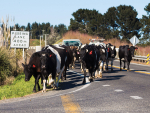
Ospri Urges Farmers To Prepare NAIT Records Before Moving Day
Moving Day (June 1) is just around the corner and farmers who are moving farms with the herd are being urged by Ospri to start preparations now.
 increase font size
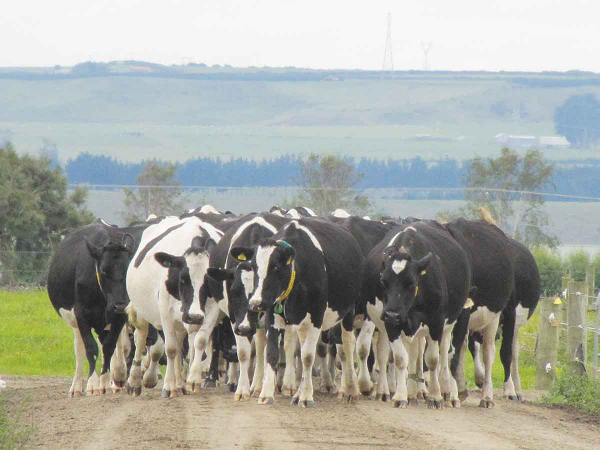
Are you moving on June 1? Don’t forget to contact OSPRI and ensure your herd records are up to date before the big day.
OSPRI, the disease management and traceability entity, says it is supporting farmers changing addresses this Moving Day.
It is urging sharemilkers moving farm and herds to call the OSPRI contact centre to ensure their NAIT account and TBfree herd records are up to date before they move.
This is essential for on-farm biosecurity and supports current livestock disease management responses.
OSPRI says it has been working alongside the dairy industry, Federated Farmers, and MPI to ensure farmers are suitably informed of their NAIT obligations during the Covid-19 national emergency.
“We acknowledge this a challenging time for dairy farmers given the restrictions around social distancing and travel,” says head of NAIT Kevin Forward.
To help minimise the load on farmers moving farm or herd, OSPRI has produced a Moving Day guide.
This has been circulated to the wider industry and can be downloaded from the OSPRI website.
As is the case every year, if moving animals to a new farm or a grazing block, farmers are required to record and confirm all livestock movements in the NAIT online system, says Forward.
“This is vital for maintaining the integrity and accuracy of the NAIT system.
“We’ve made some great progress with farmers now more engaged with their NAIT obligations and recording movements accurately and in a timely manner.
“We expect farmers will want to keep building on this and make animal traceability a priority for their on-farm biosecurity,” says Forward.
OSPRI also recommends that farmers complete a livestock transporter declaration if requested by their transporter. This relates to new legislation around the transportation of animals.
Farmers should ensure all animals are tagged and registered in NAIT. If animals are unsafe to tag, they can only be moved to a meat processor and not your new farm.
“Please remember that unsafe to tag animals [UTT] must be visibly marked and you’ll need to complete an unsafe to tag declaration and provide that to the transporter before the animals are loaded on the truck,” says Forward.
Moving Day (June 1) is just around the corner and farmers who are moving farms with the herd are being urged by Ospri to start preparations now.

Ospri is reducing TB testing frequencies and movement control measures as the disease risk subsidies in parts of the country.
From 1 October, new livestock movement restrictions will be introduced in parts of Central Otago dealing with infected possums spreading bovine TB to livestock.
The move to bring bovine TB testing in-house at Ospri officially started this month, as a team of 37 skilled and experienced technicians begin work with the disease eradication agency.
OSPRI will carry out on-farm TB testing, following AsureQuality's decision not to renew their contract.



New Zealand dairy farmers are set to be the first in the world to receive access to a new digital physical milk pricing tool that enables them to fix the price for their physical milk.
State farmer Pāmu is opening its farm gates this summer in an effort to give the rural sector the opportunity to see how large-scale, multi-system farming is delivering productivity and profitability across New Zealand.
A five-year study has found that the cost of reducing emissions without technology may be significant and unsustainable for Northland dairy farmers.
DairyNZ says Waikato farmers need certainty on Plan Change 1, but they say that certainty must be matched with practical, workable rules and a clear transition that doesn't get ahead of the new resource management system currently under review.
While the Government has moved quickly to make commercial hauliers' lot easier during the current fuel crisis, they appear to be stuck in the creep box when it comes to the agricultural industry.
Waikato farmers have been told that the Government’s new planning system legislation and the region’s Plan Change 1 (PC1) “won’t mesh together very well”.
