A Year of Delivery for Fonterra
Fonterra’s 2026 financial year was a year of delivery, with record volumes of milk collected, processed and shipped by the co-op.
 increase font size
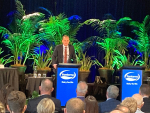
 John Wilson.
Fonterra today increased its 2016/17 forecast farmgate milk price by 75 cents to $6/kgMS.
When combined with the forecast earnings per share range for the 2017 financial year of 50 to 60 cents, the total payout available to farmers in the current season is forecast to be $6.50 to $6.60/kgMS before retentions.
Chairman John Wilson says increase reflects improvements in pricing since September, following the gradual rebalancing of global supply and demand.
“We’ve seen falling production in the major exporting regions, particularly Europe and Australia, and an unprecedented decline in New Zealand milk supply due to wetter than normal spring conditions across most regions,” Wilson says.
“On balance, demand continues to be firm. As a result there has been a steady improvement in global dairy commodity prices and this is reflected in the improved forecast.
“We are very mindful that farm incomes will be affected this year because of lower milk production so we will be doing everything possible to build on our good start to the financial year and deliver the highest possible total payout to our farmers.”
First quarter performance update
Fonterra’s first quarter revenue of $3.8 billion is up 6% on the same period last year. Sales volumes are up 2% to 4.9 billion litres liquid milk equivalent (LME), while the gross margin of 22% remains largely unchanged.
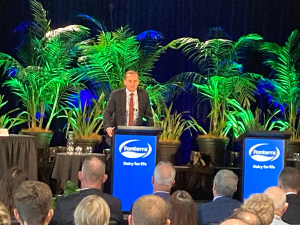
Chief Executive Theo Spierings says first quarter revenue gains reflected broad-based volume and margin growth across the business, and an ongoing focus on cost controls.
“Our operating expenses have reduced by 2% to $621 million and we continue to keep a close rein on them, in line with the financial discipline shown last year,” he says.
The cooperative has moved an additional 128 million litres LME into higher-value consumer and foodservice products compared with the same period last year.
“The consumer and foodservice business achieved an improved gross margin of 31%, up from 28%. This reflects the increasing strength of our brands in key markets and our focus on chef-led solutions in foodservice.”
Spiering says while the first quarter performance was pleasing, the cooperative’s earnings face emerging head-winds for the remainder of the financial year.
“Our current milk collection forecast is 1,460 kgMS, down 7% on last season, and this is constraining sales.
“In addition there is a potential impact from the price of Milk Price reference products, such as whole milk powder, rising faster than non-reference products.”
Spiering says given the cooperative’s stronger sales performance and lower production volumes, it continues to monitor its inventory and contracted sales position closely.
Chairman John Wilson says the cooperative has had a strong start to the year.
“The unchanged earnings guidance range of 50 to 60 cents took into account the fact that a higher milk price had the potential to influence margins across the business. However, we do expect this volatility to continue which could impact both milk price and earnings guidance. We will keep our farmers and investors updated as we move through the year,” he says.
Fonterra’s 2026 financial year was a year of delivery, with record volumes of milk collected, processed and shipped by the co-op.
Dairy farmers, still holding onto their Fonterra shares despite switching milk supply elsewhere or exiting the industry, now face a stricter share sell-down requirement.
Milk powder prices are continuing their merry run, firming up a potential $10/kgMS farmgate price this season.
Good news for Fonterra farmers. The co-op has raised this season’s farmgate milk price mid-point by 25c to $9.75/kgMS.
Fonterra board members are in line for a pay rise of around 3%.



Three men have been sentenced in District Courts after Ministry for Primary Industries prosecutions over animal welfare, food safety and cattle tracing offences.
Fonterra’s 2026 financial year was a year of delivery, with record volumes of milk collected, processed and shipped by the co-op.
OPINION: The Government's decision to reinstate agriculture and horticultural science as a standalone subject from Year 11 is the right one.
Dairy farmers, still holding onto their Fonterra shares despite switching milk supply elsewhere or exiting the industry, now face a stricter share sell-down requirement.
Hamilton-based agritech company Aimer Farming has completed a $3 million capital raise to support its next stage of growth, including a beef farming product due to launch in 2027.
When dairy manager Miriam Lauridsen learned the farm, she was joining held weekly health and safety meetings, she initially thought that was “a bit over the top”. Experiencing that culture changed her mind.