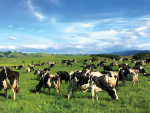
But with dairying responsible for half of NZ’s agricultural emissions and a quarter of the country’s emissions as a whole, dairying still has a big role to play in reducing the footprint, says Fonterra’s group environment manager, Francesca Eggleton. “It’s an issue we take very seriously.”
Eggleton detailed Fonterra’s continuing efforts to reduce greenhouse gas emissions, in a presentation to the New Zealand Agricultural Greenhouse Gas Mitigation Conference, which attracted 150 scientists, policy makers and industry representatives to Palmerston North in late March.
While different reporting standards makes direct comparison difficult, NZ is the world’s most efficient producer of milk on the basis of carbon dioxide equivalent per kilogram of fat protein corrected milk (FPCM) produced, with a score of only 0.89 CO2e per kg FPCM, versus a global average of 2.4 and a global high of more than 7.
Eggleton told the conference the lower footprint is likely to be associated with year-round grazing on pastures, high pasture production per hectare, low cow replacement rate and relatively low use of supplement feed.
She says Fonterra has spent at least $8 million through the Pastoral Greenhouse Gas Research Consortium for mitigation technologies research, including methane inhibitors, methane vaccines, low-emission feeds and low-emissions animal breeds. It is also working with the wider industry, with DairyNZ and others, to develop a greenhouse gas emission advisor qualification, to assess onfarm reporting models and research farm practices for greenhouse gas mitigation.
Fonterra is committed to reducing greenhouse gas emissions in all its business operations, and to moving towards cleaner technologies and energy sources. It has partnered with Z Energy to use biodiesel in its North Island tankers, for a potential decrease of emissions of 4% for each vehicle, and is converting a third of its urban fleet to electric.
She says Fonterra will work with its farmers to improve profitability, environmental efficiency and resilience to climate change and climate variability, and will advocate for appropriate policy.
“We believe... we can continue to use land productively and protect the environment. We have for generations, and our farmers care about the environment,” said Eggleton.
88% of Fonterra’s farmers have completed nitrogen reports under its nitrogen management programme.
She says farmers are already doing “great work” through riparian planting and fencing and effluent management.
“In areas... of intensification... our farmers, and councils and communities, have recognised this and are working to address it.”
Eggleton also told the conference the dairy industry was a key contributor to economies worldwide, employing 240 million people directly or indirectly. She presented figures showing dairy products generally were on the right side of the graph when compared with other foods, in terms of the ratio of nutrient density (protein, calcium, magnesium, riboflavin, selenium and vitamins B5 and B12) to greenhouse gas emissions.